Building a Scalable and Efficient Platform for Modern Agriculture
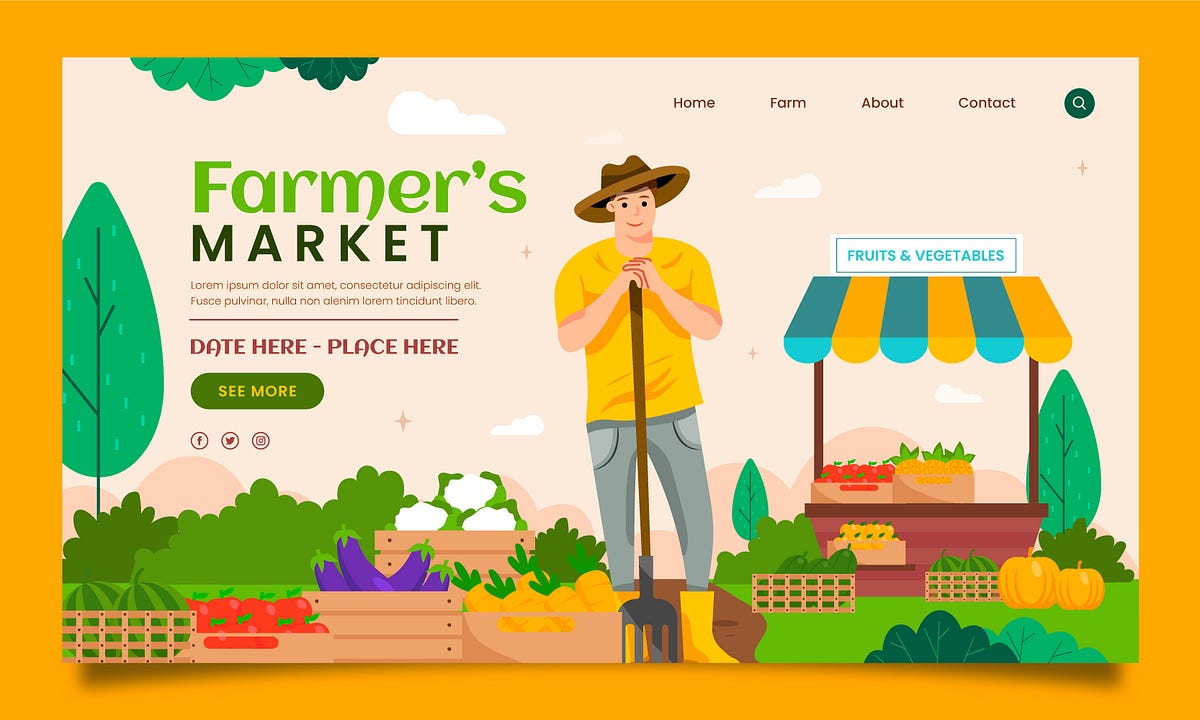
Creating an e-commerce platform for the agriculture industry is a unique challenge that requires a deep understanding of both the technical aspects and the specific needs of the agricultural community.
In this article, we’ll walk through the process of designing an agriculture e-commerce system, covering from requirement gathering to high-level architecture and best practices. Whether you’re an solution architect or just curious about the process, this guide will provide valuable insights into creating a system that can handle the demands of modern agriculture.
Disclaimer: The calculations and design presented in this article are estimations and provide a rough design for educational purposes. Actual requirements may vary based on specific use cases, user behavior and system optimizations. It is recommended to conduct detailed analysis and testing tailored to your specific project needs.
Agrifood / Agriculture E-Commerce Demand Statistics
Before diving into the specifics of designing an agriculture e-commerce platform, it’s crucial to understand the market demand and potential for such an application. The agriculture e-commerce sector is rapidly growing, driven by several key factors:
Global Market Growth
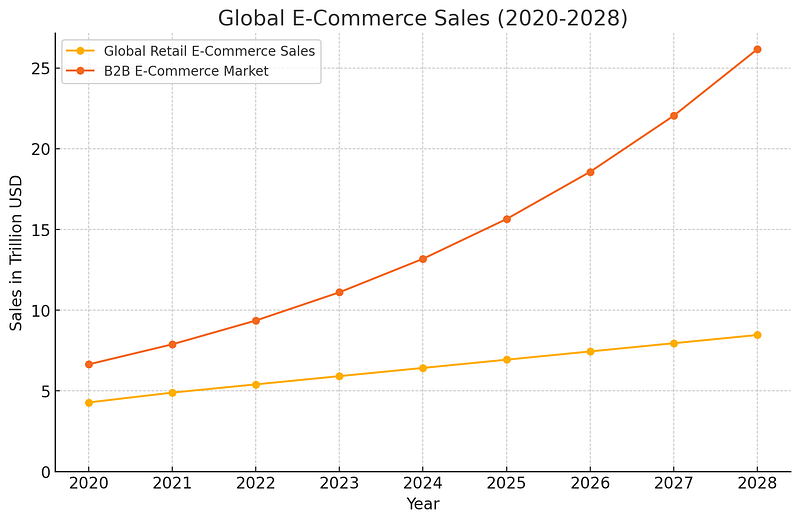
These statistics alone highlight the immense potential for e-commerce in agriculture, especially amidst changing demands and the surge in interest for safe, healthy food
Increasing Internet Penetration:
Rural internet penetration is on the rise, with many farmers gaining access to online platforms for the first time. This increase in connectivity is expanding the market for e-commerce solutions tailored to agriculture.
Demand for Efficiency:
Government Initiatives:
Consumer Trends:
Consumers are becoming more conscious of where their food comes from and are seeking out platforms that offer direct farm-to-table options, which e-commerce platforms can facilitate.
Pandemic Impact:
The COVID-19 pandemic has accelerated the shift towards online purchasing, including in the agricultural sector, as physical marketplaces faced restrictions.
Why Build an Agriculture E-Commerce Platform
Given the promising market trends and increasing demand, building an agriculture e-commerce platform is not only viable but also timely. The potential for significant growth, driven by technological advancements and changing consumer behaviors, makes it an attractive investment for startups and established businesses alike.
By leveraging these trends, an agriculture e-commerce platform can provide value to farmers and consumers, ensuring a profitable and impactful venture.
Requirement Gathering
Functional Requirements
Functional requirements define what the system should do. For an agriculture e-commerce platform, these might include:
- User Registration and Authentication: Farmers and customers should be able to create accounts, log in and manage their profiles.
- Product Listings: Farmers should be able to list their products with detailed descriptions, prices and images.
- Search and Filter: Customers should have the ability to search for products based on various criteria like category, price range and location.
- Shopping Cart and Checkout: Customers should be able to add products to a shopping cart, view their cart and proceed to checkout with multiple payment options.
- Order Management: Both farmers and customers should be able to view and manage their orders, including order tracking and history.
- Review and Ratings: Customers should be able to leave reviews and ratings for products.
- Notification System: Notifications for order status, promotions and other important updates should be sent to users via email or SMS.
- Inventory Management: Farmers should have tools to manage their inventory, including stock levels and automatic updates when products are sold.
- Analytics Dashboard: Farmers should have access to analytics on their sales, customer behavior and other important metrics.
Non-Functional Requirements
Non-functional requirements focus on how the system performs its functions. These include:
- Scalability: The system should handle increasing numbers of users and transactions without performance degradation.
- Performance: Fast load times and responsiveness are crucial for user satisfaction.
- Security: Protecting user data and transactions with encryption, secure authentication and regular security audits.
- Reliability: The system should have high availability and minimal downtime, with robust backup and recovery procedures.
- Usability: A user-friendly interface that is easy to navigate for both farmers and customers.
- Compliance: Adherence to relevant regulations and standards, such as data protection laws and agricultural regulations.
System Methodology
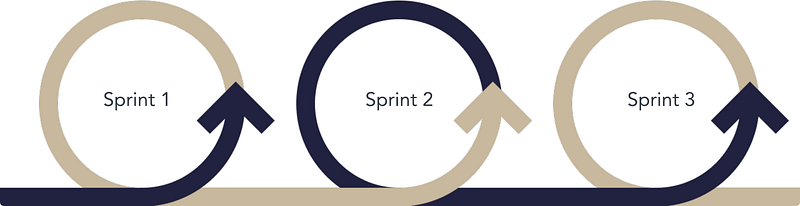
The methodology chosen for developing the agriculture e-commerce system can greatly influence its success. A popular approach is the Agile methodology. Agile focuses on iterative development, where requirements and solutions evolve through collaboration between cross-functional teams. Key benefits of Agile include:
- Flexibility: Ability to adapt to changing requirements and market conditions.
- Continuous Improvement: Regular iterations allow for continuous testing and feedback, improving the system incrementally.
- Customer Collaboration: Engaging stakeholders throughout the development process ensures the final product meets their needs.
In practice, Agile can be implemented using frameworks like Scrum or Kanban, with regular sprints, daily stand-ups and retrospective meetings to keep the project on track.
Data Fact Figure and Calculation
Understanding the data requirements and performing necessary calculations are critical for designing an effective e-commerce system.
User and Product Data
- User Data: Includes user profiles, authentication details, order history and preferences. Estimate the average data per user to plan storage and processing needs.
- Product Data: Each product listing includes images, descriptions, prices and inventory levels. High-resolution images and detailed descriptions can significantly increase data storage requirements.
Transaction Data
Order Data: Every order generates records for customer details, products purchased, payment information and delivery status. Estimating the average size of an order record helps in planning storage and processing capabilities.
Analytical Data
Usage Metrics: Data on user behavior, sales trends and other metrics are crucial for analytics dashboards. This includes tracking page views, click-through rates and conversion rates.
Data Volume Estimation
Let’s assume an e-commerce platform with 100,000 users, 10,000 product listings and 1,000 daily transactions. If each user profile is 1 KB, each product listing is 10 KB and each transaction record is 5 KB, the estimated data volume is:
- User Data: 100,000 users * 1 KB = 100 MB
- Product Data: 10,000 listings * 10 KB = 100 MB
- Transaction Data: 1,000 transactions/day * 5 KB = 5 MB/day = 150 MB/month
These estimates help in planning storage and processing needs for both short-term and long-term growth.
Storage Requirement
Based on the data volume estimation, it’s clear that the agriculture e-commerce platform will require robust storage solutions. Key considerations include:
Storage Types
- Relational Databases: For structured data like user profiles, product listings and order records. Examples is MySQL or PostgreSQL
- NoSQL Databases: For unstructured data like user activity logs, product reviews and large datasets that require high scalability. Examples is MongoDB.
- Object Storage: For storing large files like product images and videos. Examples include Amazon S3, Google Cloud Storage and Azure Blob Storage.
Capacity Planning
User Data: Assuming each user profile is 1 KB, for 100,000 users, the total storage required would be:
- 100,000 users * 1 KB = 100 MB
Product Data: Assuming each product listing is 10 KB, for 10,000 listings, the total storage required would be:
- 10,000 listings * 10 KB = 100 MB
Order Data: Assuming each order record is 5 KB, for 1,000 daily transactions, the total storage required would be:
- 1,000 transactions/day * 5 KB = 5 MB/day = 150 MB/month
Product Assets and Other Files
For product images and other necessary files, let’s assume:
Product Images: Each product has an average of 5 images and each image is approximately 500 KB. For 10,000 product listings:
- 10,000 products * 5 images * 500 KB = 25,000,000 KB = 25 GB
Other Files: Assuming each product has additional documentation or videos averaging 2 MB per listing:
- 10,000 products * 2 MB = 20,000 MB = 20 GB
Total Storage Calculation
Summarizing the total storage requirements:
- User Data: 100 MB
- Product Data: 100 MB
- Order Data: 150 MB/month
- Product Images: 25 GB
- Other Files: 20 GB
Overall, the initial database storage requirement would be:
- Initial Storage: 100 MB + 100 MB = 200 MB
- Monthly Increase (Order Data): 150 MB
- Cloud File Storage: 20GB + 25GB = 45 GB
Using cloud storage solutions can provide the necessary scalability and flexibility to handle this growth, ensuring the system can efficiently manage increasing data volumes as the user base and product listings expand.
Server Requirement
The server infrastructure needs to support the platform’s performance, scalability and reliability requirements. Key considerations include:
Server Types
- Web Servers: Handle HTTP requests, serve web pages and manage user sessions. Examples include Apache, Nginx and Microsoft IIS.
- Application Servers: Execute business logic, handle API requests and process transactions. Examples include Node.js, Laravel (PHP) and Spring Boot (Java).
- Database Servers: Store and manage data with high availability and reliability. Examples include MySQL, PostgreSQL and MongoDB.
- Cache Servers: Improve performance by caching frequently accessed data. Examples include Redis and Memcached.
- Load Balancers: Distribute incoming traffic across multiple servers to ensure high availability and reliability. Examples include HAProxy, Nginx and AWS Elastic Load Balancing.
Server Configuration
- CPU and Memory: Choose servers with adequate CPU and memory resources to handle peak loads and ensure smooth performance.
- Storage: Ensure sufficient storage capacity and IOPS (input/output operations per second) for database and file storage needs.
- Network: High-speed and reliable network connectivity to handle traffic and ensure low latency.
Capacity Planning
Estimating User Load
Let’s assume the following user metrics for our agriculture e-commerce platform:
- Active Users: 100,000
- Peak Concurrent Users: 5,000 (5% of active users)
- Average Requests per Second (RPS): 50
Web Server Requirements
Estimating CPU and Memory Needs.
Assume each web server can handle 1,000 concurrent users. For 5,000 peak concurrent users, we need 5 web servers. Each web server is configured with 4 vCPUs and 8 GB RAM.
Calculation:
- Total vCPUs: 5 servers * 4 vCPUs = 20 vCPUs
- Total RAM: 5 servers * 8 GB = 40 GB
Application Server Requirements
Estimating API Requests.
Assume each API request takes 100 ms to process. With 50 RPS, each application server needs to handle 50 requests every second. Assume each application server can handle 500 RPS.
Calculation:
- For 50 RPS, 1 application server is sufficient.
- Configure with 4 vCPUs and 8 GB RAM.
Total for Redundancy: To ensure high availability, provision 2 application servers.
- Total vCPUs: 2 servers * 4 vCPUs = 8 vCPUs
- Total RAM: 2 servers * 8 GB = 16 GB
Database Server Requirements
Estimating Storage and IOPS.
- Database size: 45.2 GB (initial) + monthly increase.
- High availability configuration: Master-Slave or Multi-AZ deployment.
- Assume 2 database servers (Master-Slave) each with 8 vCPUs, 32 GB RAM and 1000 IOPS storage.
Calculation:
- Total vCPUs: 2 servers * 8 vCPUs = 16 vCPUs
- Total RAM: 2 servers * 32 GB = 64 GB
- Total Storage: 100 GB with 1000 IOPS
Cache Server Requirements
Estimating Cache Needs:
- Assume caching 20% of database read queries.
- Assume each cache server handles 1,000 RPS.
- 1 cache server with 4 vCPUs and 16 GB RAM.
Calculation:
- Total vCPUs: 4 vCPUs
- Total RAM: 16 GB
Load Balancer Requirements
Estimating Load Balancer Capacity:
- Assume each load balancer can handle 5,000 RPS.
- Provision 1 load balancer for redundancy.
- Each load balancer with 2 vCPUs and 4 GB RAM.
Calculation:
- Total vCPUs: 2 vCPUs
- Total RAM: 4 GB
Notes: Using cloud infrastructure (AWS, Azure, Google Cloud) allows for scalable server resources. Auto-scaling groups can automatically adjust the number of servers based on traffic and usage patterns, ensuring optimal performance and cost efficiency.
High-Level Architecture
Designing the high-level architecture involves creating a blueprint that outlines the system’s components and their interactions. Here’s an example architecture for an agriculture e-commerce platform:
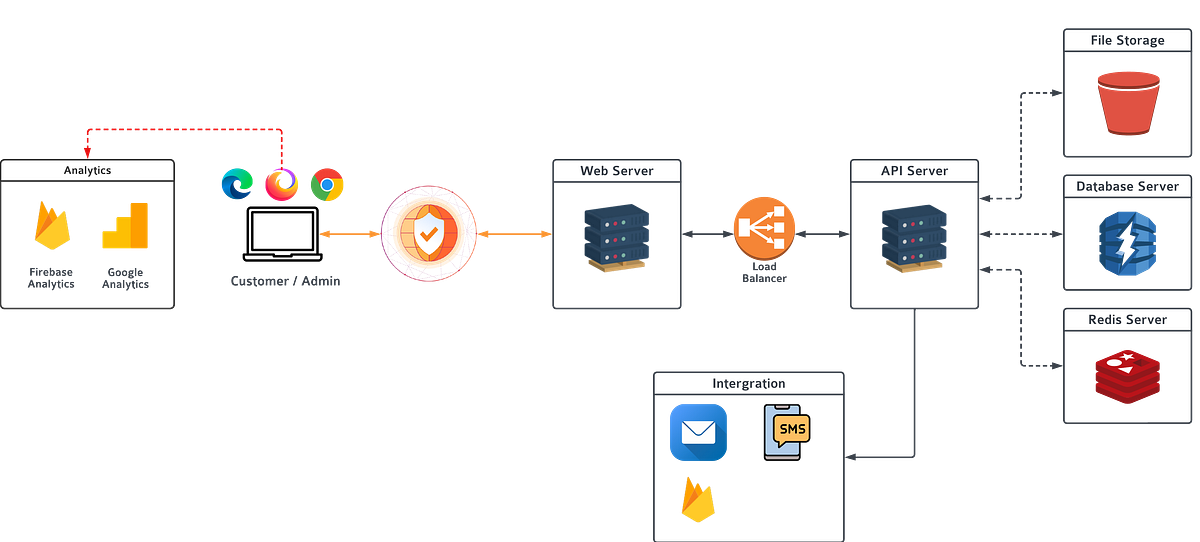
Client-Side (Frontend):
- A responsive web and mobile interface built with frameworks like NuxtJS or NextJS.
Application Server (Backend)
- Manages API requests, routing them to the appropriate services and ensuring security and rate limiting.
- Responsible for handling specific functions like user management, product catalog, order processing and payments. Each service can be developed, deployed and scaled independently.
Databases
- A database layer to store data. Utilize 2 database servers (Master-Slave).
Caching Layer
- A cache layer to store frequently accessed data and reduce load on the database.
Message Queue
- For asynchronous processing of tasks like sending notifications, updating inventory and handling background jobs.
Search Engine
- A search engine to enable fast and efficient search and filtering of products.
Analytics and Monitoring
- Tools for tracking user behavior, monitoring system performance and detecting anomalies.
File Storage
- File and assets storage with low latency.
- For example:- Amazon S3, Object Storage Service, Digital Ocean Spaces.
Estimated Project Costs
Development Costs
The development phase includes costs for a development team, tools, software licenses and consulting fees. Depending on the complexity and scale of the project, you can expect to invest between $150,000 and $300,000 for a year-long development period. Assuming a team of 3 developers and 1 designer.
- Average Developer Salary: $50,000 per year
- Average UIUX Designer Salary: $50,000 per year
- Total Salary Cost: (3 * $50,000 + $50,000) = $200,000
Infrastructure Costs and Ongoing Maintenance Costs
The infrastructure costs involve web servers, application servers, database servers, cache servers, load balancers and storage.
- Monthly infrastructure expenses can range from $1,000 to $3,000 with annual costs accumulating accordingly between $12,000 and $36,000.
Ongoing maintenance involves expenses for system administration, support staff and regular updates and bug fixes.
- Annually, maintenance costs typically fall within the $10,000 to $25,000 range, ensuring the system remains operational and secure.
Total Estimated Cost
- Initial Development: $200,000 = $200,000
- Infrastructure: $1,000 * 12 = $12,000
- First Year Maintenance: $200,000 (development) + $12,000 (server) + $10,000 = $222,000
Grand Total Estimated Cost Annually: $222,000
Note: These estimates are tailored for small startups and may vary based on project specifics and team composition. Plus, these figures serve as rough estimates and can fluctuate based on technology choices and business growth.
Best Practices
To ensure the agriculture e-commerce platform is efficient, secure and maintainable, we may follow these best practices:
Security
- Data Encryption: Use SSL/TLS for data in transit and encryption for data at rest.
- Authentication and Authorization: Implement industrial standard authentication like OAuth, JWT, Passport etc. along with role-based access control (RBAC).
- Regular Security Audits: Conduct regular security audits and vulnerability assessments.
Performance
- Load Testing: Regularly perform load testing to identify and address performance bottlenecks.
- Caching: Use caching strategically to reduce load on the database and improve response times.
- CDN: Utilize a Content Delivery Network (CDN) to serve static assets and reduce latency.
Scalability
- Microservices Architecture: Design the system using microservices to allow independent scaling of services.
- Auto-scaling: Implement auto-scaling for server resources based on traffic and usage patterns.
- Database Sharding: Distribute database load across multiple instances using sharding.
Maintainability
- Code Quality: Follow coding standards, conduct regular code reviews and use static code analysis tools to maintain high code quality.
- Documentation: Maintain comprehensive documentation for the system architecture, APIs and deployment processes.
- Testing: Implement a robust testing strategy, including unit tests, integration tests and end-to-end tests, to ensure the system functions correctly.
User Experience
- Responsive Design: Ensure the platform is responsive and works seamlessly on various devices, including desktops, tablets and smartphones.
- User Feedback: Collect and analyze user feedback to continuously improve the user interface and user experience.
- Accessibility: Design the platform to be accessible to users with disabilities, adhering to accessibility standards like WCAG.
Deployment and Monitoring
- Continuous Integration/Continuous Deployment (CI/CD): Automate the build, testing and deployment processes to ensure faster and more reliable releases.
- Monitoring and Logging: Implement monitoring and logging to track system performance, detect issues and analyze trends. Use tools like Sentry or Kibana APM.
- Disaster Recovery: Develop and test a disaster recovery plan to ensure the system can quickly recover from failures or data loss.
Customer Support
- Helpdesk System: Provide a helpdesk system for users to report issues and seek assistance.
- Knowledge Base: Maintain a knowledge base with FAQs, tutorials and troubleshooting guides to help users resolve common issues.
- Live Chat: Offer live chat support to provide real-time assistance to users.
Conclusion
Designing a agriculture e-commerce system is both a challenging and rewarding. By focusing on comprehensive requirement gathering, appropriate methodologies, accurate or nearly accurate data estimations and best practices in architecture and security, you can create a platform that truly meets the needs of modern agriculture.
Thank you for reading! Don’t forget to subscribe to stay informed about the latest updates in system design and e-commerce innovations. Happy designing!
If you found this article insightful and want to stay updated with more content on system design and technology trends, be sure to follow me on :-
Twitter: https://twitter.com/hafiqdotcom
LinkedIn: https://www.linkedin.com/in/hafiq93
Buy Me Coffee: https://paypal.me/mhi9388 /
https://buymeacoffee.com/mhitech