The invisible weekly negotiation Muslim engineers have been running in silence

Every Friday at 12:15, I am doing arithmetic.
How many pull requests are still open? Did anyone queue a deploy for this afternoon? Is there anything brewing in Slack that is about to become my problem in the next ninety minutes?
I am not panicking. I am calculating. The way I have calculated every single Friday for years.
At 12:30, I leave.
The Deadline I Inherited
Not because I treat Friday as a short day. Not because I negotiated some special arrangement with my manager.
Because Jumu’ah is obligatory.
Jumu’ah is the Friday congregational prayer. For Muslim men, it is not optional. It is not a preference. It is not a cultural practice I observe when it is convenient. Missing it without a valid reason is not a lifestyle choice in Islam. It is a sin.
I did not set this deadline. I inherited it. And every Friday, I work around it the same way I work around any hard constraint in a system: quietly, efficiently, without making it anyone else’s problem.
A 90-Minute Block, Every Week, Non-Negotiable
Here is what the prayer actually involves. A sermon, called the khutbah, followed by a two-rakaat prayer. The whole thing runs forty-five minutes to an hour at the mosque, depending on the imam. Add commute time and you are looking at a ninety-minute block in the middle of the day, every Friday, non-negotiable.
The hard stop lands right in the window that tech companies treat as prime meeting real estate.
Sprint review at 1pm. All-hands at 12:30. The Friday lunch catch-up that someone scheduled “since everyone’s already winding down.” These are not hypothetical. They are the recurring calendar events that Muslim engineers quietly navigate around, every week, without flagging it as a conflict.
The Second Sprint Nobody Scheduled

The preparation happens on Thursday evening, not Friday morning.
That is the part nobody sees. By Thursday night I have already triaged my Friday. The PR sitting since Tuesday needs to be reviewed before noon or it becomes next week’s problem. The deploy someone mentioned pushing “sometime Friday” needs to be moved to the morning or parked until Monday. The simmering non-critical production issue needs to be either resolved Thursday or documented clearly enough that whoever is on-call can handle it without me for ninety minutes.
It is a second sprint planning session. Nobody asked me to run it. Nobody knows it exists.
I do it because the alternative is leaving in the middle of something that matters, and that feels worse.
The On-Call Question Nobody Has a Clean Answer For
Then there is the on-call question, which nobody has a clean answer for.
If you are on-call on a Friday and a P1 alert fires at 12:45, what happens? I have had this conversation with myself more times than I have had it with any manager. The religious ruling is that genuine emergencies are a valid reason to miss Jumu’ah. But “the deploy pipeline is throwing errors on a non-critical environment” is not a genuine emergency, even if someone marked it P1.
So you develop a judgment that does not appear in any on-call runbook: is this actually on fire, or is this a fire drill? You make that call in about four seconds while walking to your car. Then you either turn back or keep walking.
Most of the time, you keep walking. Most alerts resolve themselves or get handled by someone else. But “most of the time” is not the same as “every time,” and the times when you kept walking and something actually needed you are the ones that stay with you.
Accommodation, Yes. Acknowledgment, No.
I have blocked my calendar for Friday prayer for as long as I can remember.
The block says something vague. “Unavailable.” Or “OOO-midday.” Or just a blank hold. Not because I am ashamed of it. Because explaining Jumu’ah in a calendar description felt like more than was required, and nobody ever asked.
Nobody ever asks.
So I protect the time myself. I field the occasional “hey, are you free around 1pm Friday?” with a reply that starts “actually I have something at that time, can we do 11 or 3?”
Accommodation, yes.
Acknowledgment, no.
There is a difference. And I have spent a long time thinking about what that difference costs.
What “Flexible Hours” Actually Covers
The tech industry has spent five years building a vocabulary around flexibility. Async-first. Remote-friendly. Work-life balance. Psychological safety. Inclusive culture.
I mean it when I say these things made a real difference.
But Jumu’ah is not in that conversation. I have never heard an engineering leader say, in a planning session or a retro or an all-hands, “let’s make sure our Friday schedule does not conflict with prayer time for the Muslim engineers on this team.”
They say “we respect personal commitments” and mean the generic version. Doctor’s appointments. School pickups. Gym routines.
Not the specific one. Not the one that repeats every week at a fixed time and cannot be moved by even five minutes because the imam starts the khutbah when he starts the khutbah.
Flexible hours means I can start at 10 instead of 9. It does not mean anyone has thought about what happens at 12:30.
I Have Checked My Phone During the Khutbah
Here is the thing I do not talk about: I have checked my phone during the khutbah.
More than once. I am not proud of it.
The rows of men listening in the mosque. The imam’s voice through old speakers. The particular stillness of that room on a Friday afternoon. It is supposed to be presence. It is supposed to be the whole point of leaving.
And there I am, phone face-down on my knee, then face-up, reading a message about a staging environment that went red on a branch I have not touched in two weeks. Or a teammate asking if I can jump on a quick call. Or a monitoring alert that turns out to be a false alarm. I will not know which until I have already broken the stillness to check.
The cost of that check is not the thirty seconds.
The cost is that I was not there. Not fully. I was in the mosque and also in the incident, and neither version of me was doing either thing properly.
The imam is speaking about gratitude. I am reading about a 503.
The Engineer Who Tries to Automate Prayer
At some point you decide to fix this properly.
You are an engineer. You schedule things. You build systems. You will build a system for this.
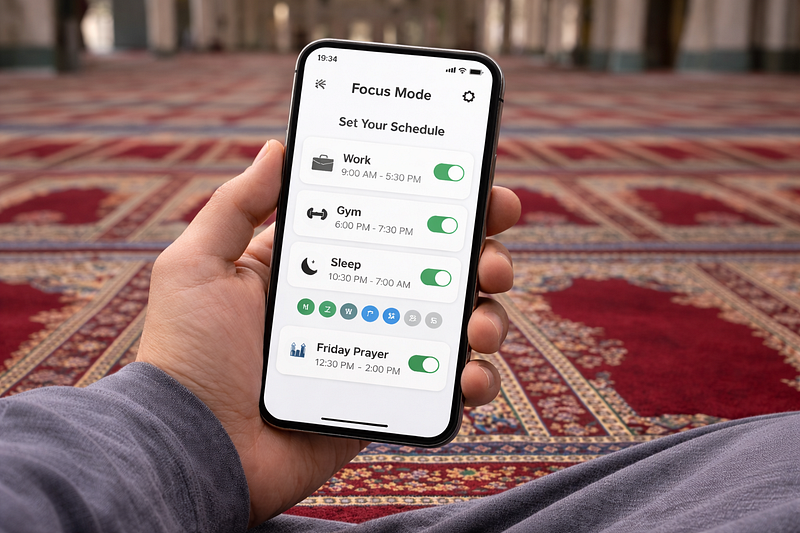
iOS has Focus modes. Android has scheduled Do Not Disturb. You create a “Prayer” focus that silences everything, activates at 12:30 every Friday, and blocks all notifications except emergency contacts. You test it. It works. Problem solved.
Then three weeks later you walk into the mosque and your phone plays a full six-second ringtone at high volume before you can get it out of your pocket.
Because prayer times shift throughout the year. The Zuhr call is based on the sun’s position, not the clock. Depending on where you are and what season it is, Jumu’ah might start anywhere between 12:15 and 1:30. The static DND schedule you set three months ago is now wrong by twenty-five minutes. You discover this in the second row with fifty men turning to look at you.
The actual solution most Muslim engineers land on is a prayer time app (Muslim Pro, Athan, Pillars) that tracks the shifting schedule and can trigger DND automatically. Some integrate it with calendar automations. Some write a shortcut. There is probably a GitHub repo for this somewhere with a single contributor and forty-seven stars.
None of it is complicated. All of it requires remembering to set it up, every time the schedule drifts far enough from your static block to matter.
And every year, at least once, you forget.
Your phone reminds the whole mosque that you are a software engineer.
The imam does not say anything. He has seen it before. He waits for you to silence it. Then he continues.
The Cost That Compounds Quietly
In some environments, the Friday prayer window is just understood. The office thins out at noon. Everyone knows. Nobody has to ask. The accommodation exists and it is acknowledged and it is easy.
That is not everywhere. Increasingly, it is not in the international-facing tech teams where the working hours, the meeting cadence and the culture are patterned after companies where Friday is just Friday.
You adapt. That is not the complaint.
Call it a complaint if you want. What it actually is: a cost that adapts quietly across time. It is the Thursday evening triage. The calendar block that never gets explained. The split attention at the mosque. The “sorry, can we shift that?” message sent for the forty-seventh time to someone who has no idea what they are being asked to shift around.
Each one is small. Each one is fine. Until you add them up across years and realize it is a significant amount of invisible work you have been doing on behalf of everyone else’s convenience.
Tolerance Is Not Inclusion
The accommodation is real. I have never been told I could not leave for prayer. I have never been penalized for the calendar block. I am genuinely grateful for that.
But accommodation without acknowledgment has a ceiling. It says: we will make room for you if you manage the logistics yourself, keep it quiet, and do not ask us to restructure anything around it.
That is tolerance. It is not inclusion.
The actual ask costs nothing. Before the next Friday sprint review goes on the calendar, before the next all-hands gets scheduled over lunch, just ask yourself: have I thought about who needs to be somewhere else at noon?
Not a policy change. Not an ERG. Just a question. Asked once. Before the invite goes out.
The prayer takes one hour.
The calculation before it takes all week.