From Laravel 12 to Laravel 13, from Laravel Cloud to AI-native tooling. A lot happened in 12 months.
If you’ve been heads-down in a project and haven’t been tracking the Laravel ecosystem closely, the past year would genuinely surprise you. Laravel didn’t just release a new major version and call it a day. The team shipped a cloud deployment platform, a first-party AI development tool, a real-time broadcasting server, a complete overhaul of starter kits and more tooling in one calendar year than most frameworks produce across several. This article is a practical rundown of what changed, what it means for your work and what’s coming next.
Laravel 12: Released February 2025, Still Relevant Now
Laravel 12 dropped on February 24, 2025. Unlike some major releases that arrive with sweeping breaking changes, Laravel 12 focused heavily on developer experience and foundation work. It’s not a flashy release. But it’s a very solid one.
The biggest visible change was the completely reworked starter kits. Laravel 12 shipped with official first-party starter kits for three frontend approaches: React with Inertia.js, Vue 3 with Inertia.js and Livewire 3. Each kit comes pre-configured with TypeScript, Tailwind CSS and modern component libraries. The React kit uses shadcn components. The Vue kit uses shadcn-vue. The Livewire kit ships with Flux UI. Every kit includes authentication out of the box: login, registration, password reset and email verification ready to go.
This is a significant shift from the previous era where you had to choose between Breeze and Jetstream and then bolt on your frontend setup separately. Now you pick your stack from one place and get an opinionated but production-ready starting point.
On the performance side, Laravel 12 brought improved asynchronous caching, smarter database query execution and better memory management. These are not headline features you’ll write a blog post about, but they’re the kind of improvements that show up as faster response times under real production load. Background job processing also got faster, with queues draining more efficiently at high volume.
PHP version requirements for Laravel 12 are 8.2 through 8.4, so you have some flexibility there. Support runs until August 2026 for bug fixes and February 2027 for security updates. That’s a comfortable window.
What Laracon US 2025 Actually Announced
Laracon US 2025 happened in September 2025 and was one of the denser announcement keynotes the Laravel team has put out. Here’s what actually shipped from it.
Laravel Cloud moved from developer preview to a proper release. MySQL support went general availability with production-ready sizing from 1 CPU/512 MB all the way up to 16 CPU/64 GB RAM and storage options from 5 GB to 1 TB. Daily automated backups with customizable retention windows are included. The team also simplified pricing: a free Starter plan (formerly Sandbox) with custom domain support, a Growth plan starting at $20/month with Queue clusters and Preview Environments and a Business plan for high-compliance or complex enterprise setups. Queue autoscaling became available in developer preview, introducing a dedicated cluster type just for queue workloads.
Laravel Forge got a next-generation rebuild. The new Forge brings instant provisioning via Laravel VPS, zero-downtime deployments and automated SSL with a modern redesigned interface.
Laravel Nightwatch launched as a first-party observability platform. Monitoring, logs and insights specifically built for Laravel applications, with developer-friendly pricing introduced at Laracon.
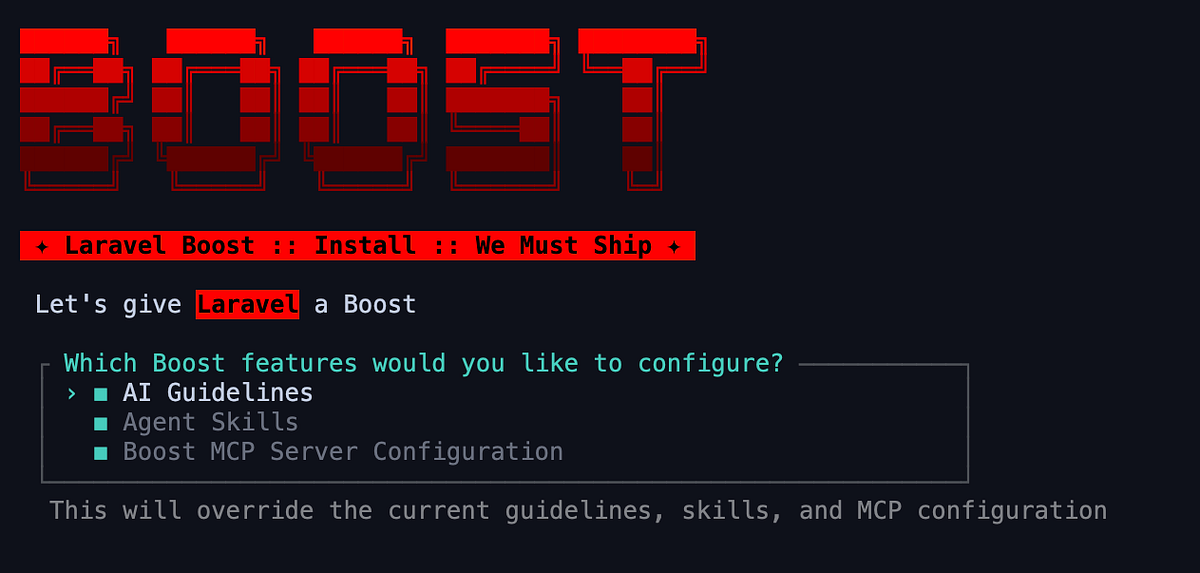
Laravel Boost was previewed at the keynote and released as a public beta two weeks later. This one deserves its own section below.
Laravel MCP was announced as a library for building Model Context Protocol servers directly from your Laravel application. The idea is that your app can expose itself as an MCP source so AI agents can interact with it natively. A natural companion to Boost.
InfiniteScroll component landed in Inertia, available for React, Vue and Svelte. You wrap your list in the component and infinite scroll just works.
The changelog also showed smaller but useful additions: Str::plural got a prependCount argument, SQS fair queues became supported and the exception page was redesigned to show local errors more clearly.
Laravel 13: Expected Q1 2026
Laravel follows an annual release cycle and Q1 is always when the new major version lands. Laravel 13 is due right around now, in the first quarter of 2026. The big change is the PHP version floor: Laravel 13 will require PHP 8.3 or higher. PHP 8.2 support is being dropped.
This matters because PHP 8.3 brings real improvements. Better error handling, JIT compiler optimizations and a more expressive type system. By requiring 8.3, the team can strip out compatibility layers and write cleaner internal code.
Laravel 13 is being described as a maintenance release in terms of new features. That’s not a criticism. It means the focus is on removing legacy components, tightening the architecture and setting up the foundation for what comes next. A new Reverb database driver is also expected, building on the WebSocket infrastructure the team has been growing over the past couple of years.
Laravel 12 support runs until August 2026 for bug fixes and February 2027 for security fixes. So even if you’re not ready to jump to 13 immediately, you have time to plan the upgrade properly.
Laravel 13 is the next major release of the Laravel framework, scheduled for March 2026.laravel-news.com
The Ecosystem Packages Worth Knowing About
Beyond the framework itself, a few things in the broader ecosystem have grown significantly in the past year.
Livewire 4 has been in beta. If you’re using Livewire 3, the upgrade path is being documented actively. The performance improvements in v4 are notable enough that it’s worth planning for.
Filament v4 has been in development, promising faster admin panels with a more flexible architecture. Filament has become the go-to admin panel builder for Laravel applications and v4 is a significant step forward.
Laravel Reverb, the first-party WebSocket server, has seen continued improvement since its launch in Laravel 11. For applications that need real-time features like chat, live notifications or collaborative interfaces, Reverb removes the need for external WebSocket services like Pusher. Running your own WebSocket server used to mean standing up a separate Node.js service. Now it’s a first-party Laravel package.
Laravel Scout with database driver improvements means full-text search is more accessible for smaller applications that don’t want to manage Meilisearch or Elasticsearch. For applications under a certain scale, the database driver is genuinely good enough now.
Laravel Cloud vs Forge vs Vapor: Which One Do You Need?
With three official hosting/deployment products now in the picture, it’s worth being clear about what each one is for.
Vapor is Laravel’s serverless deployment platform built on AWS Lambda. It’s for teams that want serverless scaling and are already comfortable in the AWS ecosystem. Cost scales with actual usage rather than provisioned resources. It’s been available for years and is mature.
Forge is a server management tool. You bring your own VPS from DigitalOcean, Hetzner, AWS or wherever. Forge handles provisioning, deployments, SSL, PHP version management and monitoring. It’s been the standard for self-managed Laravel deployments for a long time. The new generation that launched at Laracon 2025 adds instant provisioning through Laravel VPS and zero-downtime deployments by default.
Laravel Cloud is the newest of the three and is the most hands-off. You push code and the platform handles everything: compute, database, queues and scaling. It’s positioned as the simplest path to production for teams that don’t want to think about servers at all. The MySQL GA launch at Laracon 2025 was a key milestone because a managed database had been the missing piece.
For most solo developers or small teams building standard web applications, Cloud is going to be the most frictionless choice. For teams with specific infrastructure requirements or compliance needs, Forge still gives you more control.
Why the Ecosystem Feels Different Now
Here’s the honest observation about where Laravel stands in early 2026. The framework itself is well-established and not going anywhere. But what changed in the past 12 months is that the surrounding ecosystem became genuinely comprehensive.
A year ago, deploying a Laravel application required making external decisions: which cloud provider, which database service, which WebSocket solution, which monitoring tool. Today, for a significant range of applications, you can stay entirely within the Laravel product family. Cloud for deployment, MySQL for database, Reverb for WebSockets, Nightwatch for observability, Horizon for queue monitoring. The tools talk to each other. The documentation is unified. The team is building all of it.
This doesn’t mean you have to use all of it. But having a coherent, maintained, opinionated set of first-party tools is valuable. It reduces the number of integration decisions you have to make and the number of external vendor relationships you have to manage.
The investment the team has put into AI tooling (Boost, MCP, the AI SDK) shows a clear bet that the future of web development involves AI agents operating within your application context. The early results of that bet are already visible in how much more useful AI coding assistants are when you give them proper framework context.
Laravel isn’t trying to be everything to everyone. It’s trying to be very good at the specific combination of backend API, full-stack web application and modern PHP development. In 2026, that combination remains relevant for a very large portion of the applications being built.
The question is no longer whether Laravel is a serious choice. It clearly is. The question is whether you’re taking advantage of what the ecosystem now offers, or whether you’re still assembling the same pieces manually out of habit.
Laracon EU 2026 is scheduled for March 2–3 in Amsterdam. Expect more announcements around Laravel 13 and the next phase of the Cloud roadmap.