Three valid ways to structure a day. The real problem isn’t which one you pick. It’s the invisible standard you keep failing against.
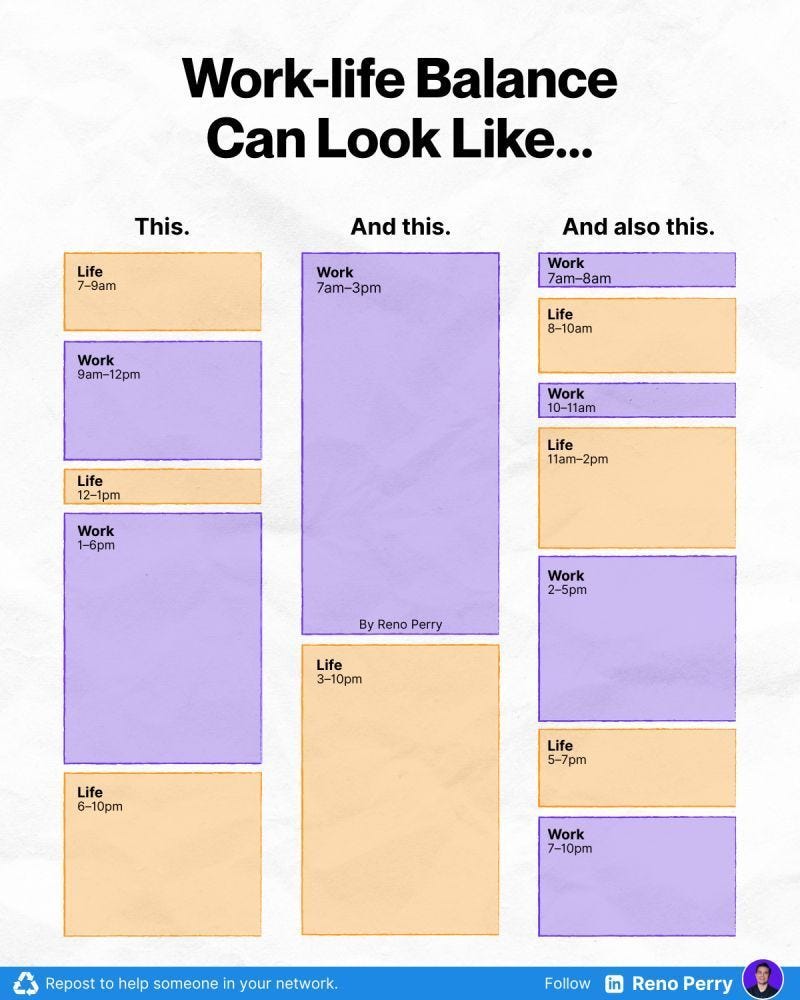
There is an infographic that circulates on LinkedIn. It shows three columns, each a different way to split a day between work and life. One has two clean blocks of work sandwiched by life on either end. Another is a single long block of work in the morning followed by an unbroken afternoon of life. The third is a checkerboard: work and life alternating throughout the day in short, interlocking segments.
At the bottom: “Work-life balance can look like this. And this. And also this.”
People share it because it resonates. But most of them then go back to feeling guilty about the schedule they’re actually keeping, because it doesn’t look like any of the three columns. It looks like something messier. Something that shifts week to week. Something they apologize for.
That guilt is the real problem. Not the schedule.
The Standard Nobody Agreed to Follow
At some point, without any formal announcement, a specific shape of the workday became the default measure of whether someone was doing life correctly. It starts between eight and nine in the morning, ends somewhere between five and six in the evening, takes a break at noon, and draws a clean line between professional time and personal time.
This pattern exists for historical and industrial reasons. Factory shifts needed coordination. Banks needed overlapping hours. Schools organized around it. The 9-to-5 was a labor rights achievement. Before it, there were no limits at all. For most of the 20th century, it was a protection, not a philosophy.
But somewhere it became a philosophy. It started measuring not only when people worked, but whether they were serious. Whether they were professional. Whether they had their life together.
The pattern hardened into a standard. And the standard became invisible, the kind of rule you absorb without anyone stating it, and then hold yourself against without ever questioning where it came from.
What Biology Actually Says About Your Best Hours
Here is what makes the invisible standard particularly unfair: it ignores the fact that people are not biologically identical in when they think best.
Your chronotype is your body’s natural inclination toward wakefulness and sleep, and it is not a matter of habit or discipline. Research is clear that chronotype has a significant genetic component. You can no more choose it than you choose your height. Some people genuinely fire on all cylinders between six and ten in the morning. Others do not reach full cognitive capacity until late afternoon. Both are normal. Both are real.
Circadian rhythm research has identified two windows of natural peak alertness for most people: late morning and late afternoon. But the timing of those windows shifts by several hours depending on whether someone is a morning or evening chronotype. An evening type whose peak arrives at two in the afternoon is not being lazy by struggling through a nine o’clock meeting. They are fighting their own biology, and they will lose productive hours as a result.
Studies on evening-type workers forced into early schedules find measurable performance differences when they are allowed to work during their natural peak hours instead. This is not about preference. It is about matching output to physiology.
The standard workday was never designed with chronobiology in mind. It was designed around shift overlap. Those are different things.
Three Real Schedules, All Working
The image with the three columns is doing something important: it is naming structures that exist but rarely get permission to exist openly.
The first pattern, the one most people recognize, sandwiches work between morning and evening life and breaks the work block with a midday pause. It matches well for people whose energy peaks in the late morning, drops at lunch, and recovers in the mid-afternoon. The traditional day was built for this curve.
The second pattern front-loads work into a single unbroken morning block and gives the back half of the day to life. This suits people with strong morning focus who fade by early afternoon, or people with childcare responsibilities that make evening availability valuable, or people who prefer their recovery time when they still have energy for it rather than after it has run out.
The third pattern, the checkerboard of alternating work and life throughout the day, is the one most people are afraid to admit they actually use. Work for an hour, walk the dog, work for two hours, handle a personal errand, come back in the evening for another focused block. It looks scattered. It feels like it should not be allowed. But for people with high-context-switching tolerance, caregiving responsibilities, or naturally irregular energy patterns, it can outperform both of the other models.
None of these is the right answer. None is wrong. They are tools, and a tool is only correct relative to the job it needs to do.
The Cost of the Performance
What makes the invisible standard dangerous is not that it exists. It is that it drives people to perform it rather than find what actually works.
Researchers studying workplace monitoring have found that employees subject to heavy surveillance spend significant time in what some call “productivity theater”: performing busyness for dashboards and managers rather than doing the work that actually matters. The time spent looking productive actively competes with being productive.
The same dynamic operates at the level of life structure. When you spend energy making your schedule look balanced rather than finding a rhythm that actually sustains your output, you are doing productivity theater for an invisible audience. You check in at the expected times. You do not mention that you did your best thinking at eleven at night. You apologize for working at three in the afternoon after a two-hour break. The performance is exhausting in itself.
Stanford research has established that productivity drops steeply beyond 50 hours of work per week and effectively plateaus beyond 55 hours, meaning the additional hours produce almost nothing measurable. The pattern repeats at the daily level. Past a certain point in any cognitive session, output declines. Forcing yourself to stay in your chair when your brain has already checked out does not generate work. It generates the appearance of work.
The people who look the busiest are not always the people producing the most. This is the irony at the center of the invisible standard. The performance of discipline costs as much as it gains.
What Burnout Is Actually Measuring
Burnout is not a character flaw. It is a physiological response to sustained misalignment between what your body and mind need and what your circumstances are demanding.
The numbers on workplace burnout have become increasingly grim. Recent reports indicate that somewhere around 85 percent of workers are experiencing symptoms of burnout or exhaustion, and that burnout costs businesses over $300 billion annually in lost productivity and healthcare. Seventy-two percent of employees experiencing burnout report a direct decline in their output. The productivity that was being protected by all the looking-busy has been lost anyway, at scale, over time.
What is significant about these numbers is the direction of causation. The assumption embedded in grind culture is that pushing harder produces more. The evidence says that at population scale, pushing harder past sustainable thresholds produces sicker people who then produce less. The discipline that was supposed to protect performance is eroding it.
The people most at risk are rarely the ones who are not trying hard enough. They are the ones trying to perform a schedule that was never built for them.
Permission Is Not the Same as Approval
Shifting to a schedule that actually fits you requires something that feels uncomfortable: deciding that your results matter more than your process looking recognizable.
This is harder than it sounds, because the invisible standard does not live in your employee handbook. It lives in the assumptions behind offhand comments. It lives in the slight hesitation before you mention you took a two-hour break in the middle of the day. It lives in the way you frame your morning runs as “I hadn’t started work yet” rather than “I worked until ten last night and banked recovery time.”
The shift is not about convincing anyone else. It is about stopping the internal measurement against a standard that was never designed for you and was never formally endorsed by anyone in a position to judge your actual output.
Knowing when you perform best is not self-indulgence. Planning around that knowledge is not laziness. Working in patterns that other people do not recognize as working is not unprofessional, if the work gets done and you remain functional while doing it.
Rest is not the opposite of productivity. It is one of its inputs. The people who sustain high performance over years rather than burning brightly for months and then collapsing have almost always found some version of this truth: recovery is not a reward for finishing. It is a requirement for continuing.
What This Actually Requires
Finding the rhythm that works for you is an active process, not a discovery. Most people do not arrive at it by reading about chronotypes and then immediately restructuring their days. They arrive at it by paying attention to when their energy is actually high, when their thinking is actually clear, and when they are performing versus performing performance.
That attention is harder to sustain in environments that treat all hours as equivalent and all workers as interchangeable. But the cost of not sustaining it is accumulated in burnout statistics and in the quiet private recognition that you have been grinding at the wrong hours and wondering why the output does not match the effort.
None of the three schedules in the image is right. Neither is the one you have been apologizing for. The question worth asking is not whether your day looks correct. It is whether it is building toward what you actually want to build, without dismantling the person doing the building.
That is a narrow target. It takes iteration. It looks different for different people, and it looks different for the same person at different stages of life.
The goal is not to find the perfect schedule and hold it forever. The goal is to stop measuring yourself against a standard that was built for a factory, not for the kind of work you are actually doing.
Your schedule does not need approval. It needs to work.
Edited by Tanmoy Das