The knowledge gap between product decisions and production reality is not a communication problem. It is a structural one.
There is a specific kind of silence in sprint planning that I have learned to recognize.
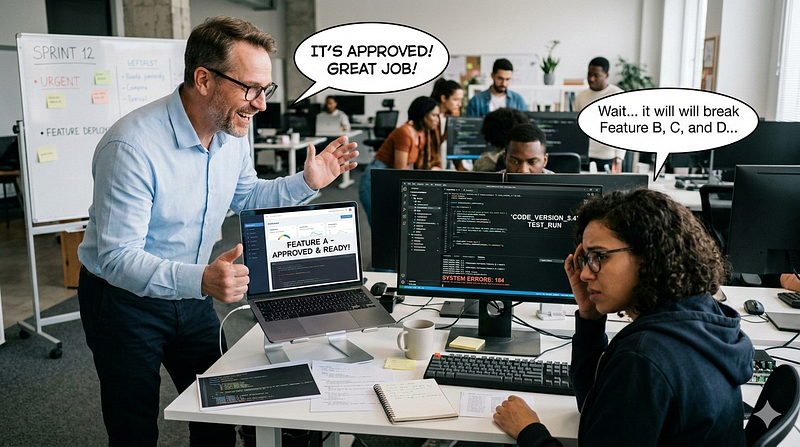
Someone walks in with a requirement that came from above. The manager explains it. The product owner adds context. The timeline gets agreed on. And then, for about four seconds, nothing happens. The developer in the room says nothing. They are not being difficult. They are not disengaged.
They are doing math in their head that nobody else in the room has the data to do.
The Meeting Where I Watched It Happen in Real Time
We had a water utility client. Long-running Laravel monolith, six years of production history, more legacy logic baked into the codebase than any of us cared to admit out loud.
The business team came in with what seemed like a simple feature: change how billing cycles were calculated for a specific customer category. The product manager walked us through it.
“It is straightforward. Two inputs, one output. The logic is clean. Can we get this done by end of sprint?”
The room nodded. I wrote it down. I said nothing.
Then I went back to the codebase and spent the next hour tracing every place billing calculation was referenced. It was not in one service. It was threaded through the meter reading sync job, the arrears flag logic and the SMS notification trigger that fired when accounts passed a threshold. Changing the calculation without knowing that would have sent incorrect overdue notices to roughly 400 accounts and silently corrupted the arrears report that the finance team used every month.
None of that was in the ticket. None of it ever makes it into a ticket.
The feature was fine. The feature was actually simple. What was not simple was the business rule living three layers beneath it that nobody had documented because the developer who knew about it left in 2019.
What Developers Are Actually Carrying
Developers are the only people in the organization who have actually read the code.
That sounds obvious until you realize what it means in practice.
A developer working on a system for more than six months starts accumulating context that has no home anywhere in the organization. Not in Jira. Not in Confluence. Not in any retrospective. It lives in their memory as a collection of quiet warnings: “do not touch this without checking X first,” “this job runs at midnight and it reads from the same table,” “the client has a workaround for this that will break if we change the column type.”
This is not documentation debt, though that is part of it. It is the natural result of how software systems age. Business rules get encoded into code because writing them down in plain language felt like extra work at the time. Edge cases get handled inline because raising a ticket felt like slowing things down. Workarounds get built on top of other workarounds until the original problem is buried three abstractions deep.
The developer sees all of this every time they open a file. The manager sees none of it because there is nowhere for it to live except inside the developer’s head.
Why Developers Stay Quiet
Here is the uncomfortable part.
Developers often know the downstream impact before anyone else does. They stay quiet anyway. Not always because they are conflict-averse, though sometimes that is true. They stay quiet because they have learned how raising concerns tends to go.
It usually sounds something like this:
Developer: “This touches the arrears logic. If we change the billing calculation here, the nightly sync job will produce wrong numbers.”
Manager: “Can we just be careful when we build it?”
Developer: “I mean, it is more than that. The sync job reads from the same“
Manager: “Put it in a follow-up ticket. Let us not block the sprint.”
The follow-up ticket never gets prioritized because something else came up. The risk you flagged becomes someone else’s incident three months later and by then nobody remembers the conversation.
After two or three cycles of this, developers learn to speak up less. Not because they stopped seeing the risks. Because the organizational incentive structure made raising them feel pointless.
This is the real knowledge gap. Not that developers and managers have different information. It is that the system gives developers no reliable mechanism to surface what they know and have it actually change a decision.
How to Surface It Without Looking Like You Are Blocking Progress
This is the practical part and I want to be specific because “just communicate better” is useless advice.
Write the impact as a list of facts, not a concern.
Concerns get dismissed. Facts require a response. Instead of saying “this might affect the billing logic,” say:
“This touches three places: the billing calculation inBillingService.php, the arrears check in the nightly sync job and the SMS trigger inNotificationDispatcher. If we change the calculation without updating all three, the arrears report will be incorrect from the next billing cycle."
Specificity is armor. Vague concerns sound like resistance. Specific facts sound like information.
Attach a size estimate to the invisible work.
Most managers are not trying to ignore technical risk. They genuinely do not know it is there. When you surface hidden dependencies, give them a number. “This is a two-day feature that has four hours of invisible prep work underneath it.” That framing respects the timeline and makes the hidden work legible. It is not a blocker. It is a budget.
Use the ticket as your paper trail, not the meeting.
Meetings are where decisions get made and then immediately misremembered. If you raise a concern in a meeting and it gets acknowledged but not acted on, document it in the ticket before the day ends:
“Flag raised in planning: this change affects the arrears calculation in the nightly sync. Confirmed with [name] that we will handle the migration before deploying to production.”
Now there is a record. The conversation happened and it is attached to the work. This protects you. It also forces the decision into a written space where it is harder to quietly ignore.
Name the assumption you are being asked to make.
A lot of “just build it” instructions carry an unstated assumption underneath them. Your job is to name it out loud.
You: “I can build this by Friday if we are assuming the billing calculation change does not affect the arrears logic. Do you want me to verify that first or proceed on that assumption?”
You are not blocking anything. You are making the assumption explicit so the person approving it is actually approving it with information.
Create a living dependency note for the systems you own.
This is the one that pays off over time. Keep a short markdown file for each major system you maintain. Not full documentation. Just a list of things that are non-obvious: jobs that depend on this, tables shared with other features, business rules encoded as code, clients with known workarounds. The goal is five to ten lines per system. Something that takes ten minutes to write and saves three hours of context-switching six months later.
When a ticket comes in that touches that system, paste the relevant lines into the ticket. It takes thirty seconds and it turns invisible context into visible information.
The Real Fix Is Institutional, But You Cannot Wait for It
The structural problem is that most engineering organizations treat developer system knowledge as a personal asset rather than an organizational one. It lives in people’s heads, it walks out the door when they leave and it only becomes visible when something breaks.
The fix for that is a cultural shift that takes years and requires buy-in from people who are not reading this article.
The four seconds of silence in planning are not the gap. They are the symptom.
The gap is everything that should have been written down before the meeting started.
What you can do right now is build the habit of translating your invisible context into written facts before a decision gets made. Not to slow things down. Not to look smart. But because the person approving the feature genuinely does not know what you know, and the cost of them finding out after the deploy is almost always higher than the cost of a ten-minute conversation before it.
The developer in that sprint planning meeting who said nothing? I was that developer more than once. The silence felt like professionalism at the time. It was not. It was a failure to do the one part of the job that no ticket ever asks for: making what I know available to the people who need it before it becomes a problem.
If you are a technical dev managing systems with significant production history, the single highest-leverage thing you can do this week is spend one hour writing down the non-obvious dependencies for your three most critical systems. Not a wiki. Not formal docs. Just a list of things that will bite the next person who touches them without knowing.