The real difference between engineers and architects has nothing to do with titles, experience levels or how many AWS services you can name.

Most engineers I know are excellent at solving the problem in front of them. They write clean code, optimize for performance and ship features that work exactly as described in the ticket.
That is not what architects do.
And confusing the two roles is one of the most expensive mistakes a team can make. Not expensive in the way a bad sprint is expensive. Expensive in the way a wrong database choice at year one is expensive when you hit it at year three.
What is a software engineer
A software engineer builds things. Their primary output is working software: features that function correctly, code that other engineers can read and maintain and systems that hold up under the conditions they were designed for.
The engineer’s domain is the solution. Given a clearly scoped problem, they figure out the most correct and efficient way to implement it. That means choosing the right data structure, writing tests that actually catch regressions, handling edge cases and making sure the thing they ship does not become someone else’s incident at 2am. Good engineers care deeply about quality inside the boundaries of what they are building.
What engineers are generally not accountable for is what happens outside those boundaries. The downstream systems. The organizational consequences. The decisions that come three quarters later because of the choices made today. That is not a gap in skill. It is a difference in scope.
What is a software architect
A software architect makes decisions that other people have to live with. That is the most honest definition I have found.
Their primary output is not code. It is decisions: about system boundaries, data ownership, service contracts, consistency models and the interfaces between teams. An architect determines which problems are worth solving at the infrastructure level versus the application level, which coupling is acceptable and which coupling will quietly destroy your team’s ability to ship in two years.
The architect’s domain is consequences. Not just the immediate consequence of a single decision but the cascading effects of that decision on the decisions that follow it. They are thinking about what the system looks like when the team doubles in size, when a key assumption turns out to be wrong or when a third-party dependency changes its pricing model and you need to swap it out in three weeks.
Two roles, two entirely different questions
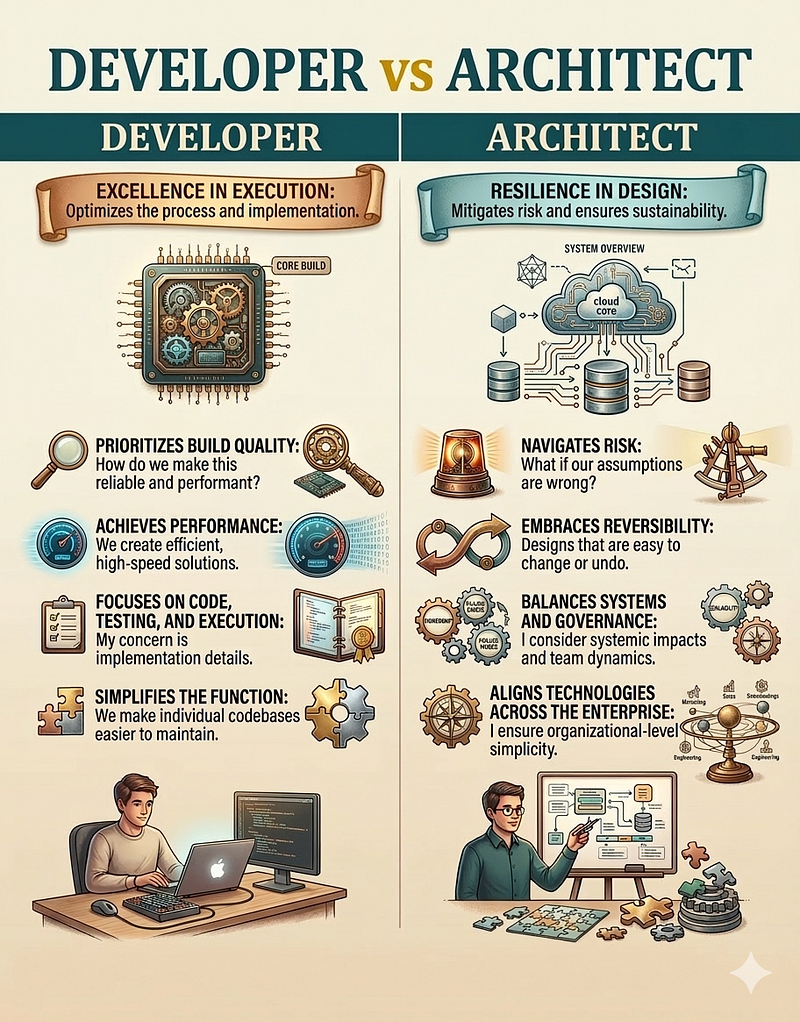
They are not junior and senior versions of the same job. They are solving fundamentally different classes of problems, and the distinction starts with the question each of them asks when a requirement lands on the table.
The engineer asks: How do we build this well?
The architect asks: What happens if we are wrong?
Read those twice. They are not the same question dressed up differently. They pull your attention toward completely different parts of the problem space. The engineer is asking about execution quality. The architect is asking about survivability.
This is not a criticism of engineers. It is a description of scope. An engineer’s job is to make the solution correct and efficient. An architect’s job is to make sure the organization can survive the consequences of decisions made today when conditions change tomorrow.
Both jobs matter. Neither job is more important. But conflating them produces teams that either ship fast and break at scale or spend six months in architecture review and never ship anything at all.
Engineers optimize the solution. Architects optimize the consequences.
This is the clearest framing I have found.
When an engineer approaches a problem, they are working inside the solution space. The question is already defined. The task is to answer it as cleanly, efficiently and correctly as possible. Caching strategy, query optimization, test coverage, code structure, error handling. All of this is solution-space work. It is genuinely hard and genuinely important.
When an architect approaches the same problem, they are working in a different space entirely. They are asking what this decision closes off. What it assumes will remain stable. Who owns this component if the engineer who built it leaves in six months. What the blast radius looks like when an upstream service changes its contract without warning.
These are not better questions. They are different questions. And the mistake most organizations make is assuming that a senior enough engineer will naturally start asking them without ever being given the explicit responsibility to do so.
Sometimes that happens. Often it does not.
Architecture is not about drawing diagrams. It is about choosing which consequences you are willing to live with.
That is not a poetic reframing. That is literally what the job requires. Every architectural decision is a bet on which assumptions will hold and which failure modes are acceptable. The diagram is just the documentation of that bet. The bet itself is the work.
The irreversibility problem
Every system contains two types of decisions. Reversible ones and irreversible ones.
Choosing a variable name is reversible. Refactoring a component is reversible. Picking a UI library is mostly reversible, painful but survivable. These are what Jeff Bezos called Type 2 decisions. You can walk back through the door.
Choosing your primary database engine when you already have 400 GB of production data is not reversible. Not in any practical sense. Building your authentication layer on a custom Keycloak instance that three other services now depend on is not reversible without significant coordination cost. Designing your service boundaries around a monorepo assumption and then trying to split teams across those boundaries two years later is not reversible without rewriting ownership models, deployment pipelines and half your API contracts.
These are Type 1 decisions. Once you go through that door, the door locks behind you.
Engineers can and should think about reversibility. But architects specifically exist to protect the organization from making irreversible decisions casually, in the middle of a sprint, without the right people in the room.
The architect is the person who stops a planning session and asks: if this assumption turns out to be wrong in six months, what does it cost us to change course? What would we have to rewrite? What teams would be affected? What contracts would break?
That question alone, asked consistently and early, is worth more than any architecture diagram ever produced.
Optimizing for performance versus optimizing for reversibility
These two goals are often in direct tension and that tension is where the real architectural thinking happens.
Performance optimization usually means commitment. You cache aggressively because you have decided the data changes slowly. You denormalize because you have decided read performance matters more than write flexibility. You build a tight coupling between two services because the latency cost of a network call is too high.
All of these are legitimate engineering decisions. They are also decisions that reduce your options later.
Reversibility optimization means staying loose where looseness is affordable. It means designing interfaces that can change their implementation without breaking their callers. It means separating the data model from the query model so you can optimize each independently. It means building the seam in the right place so that when requirements change you are cutting along a joint rather than sawing through bone.
The architect’s job is not to tell the engineer their performance optimization is wrong. It is to ask whether the performance gain is worth the optionality cost. Sometimes the answer is yes, obviously. Sometimes the answer is no. Most of the time the answer is: it depends on assumptions we have not yet made explicit.
Making the implicit assumptions explicit is most of what architecture actually is.
What architectural thinking looks like in practice
It is not about knowing more tools. It is not about having a decade of experience. It is a specific mode of reasoning that some engineers develop naturally and others never do, regardless of their seniority level.
You are thinking architecturally when you start reasoning about these four things consistently.
Irreversible decisions. You have developed the instinct to flag which choices lock the organization in and which do not. You do not treat all decisions with the same weight. You slow down specifically for the ones that close doors.
Tradeoffs over tools. You have stopped asking which tool is best in the abstract and started asking which tool is best given this team’s constraints, this organization’s hiring pipeline and this project’s timeline. The best tool for the job and the best tool for the team are often different tools and the architect knows which conversation they are actually having.
Constraints over possibilities. Junior engineers list everything the system could do. Architects define what the system explicitly will not do. Constraints are not limitations. They are load-bearing walls. The ones you pick determine the shape of everything built inside them.
Second-order effects. Every architectural decision makes future decisions easier or harder. The architect tracks this. When service A takes a dependency on service B, what does that do to the team that owns service C which also depends on B? When you choose eventual consistency for this data store, what does that mean for the feature that needs to read your own writes? These downstream effects are the architect’s native territory.
None of this requires a whiteboard. None of it requires a title. It requires a specific intellectual discipline that most engineers start developing naturally over time but only if someone around them is modeling it and creating space for the conversation.
The complexity problem: inside the function versus across the organization
Engineers reduce complexity inside the function. Architects reduce complexity across the organization.
This distinction is subtle but it matters enormously when you are trying to understand why large systems become hard to change.
An engineer makes a module clean, testable and well-documented. They extract the right abstractions, name things clearly and write tests that actually fail when the behavior breaks. This is excellent work. The function is a good citizen.
But complexity does not disappear when you clean up a function. It migrates. It accumulates in the interfaces between functions, between services and between teams. It lives in the undocumented assumptions about who calls what in which order. It lives in the implicit contracts that nobody wrote down because everyone on the team just knows.
The architect’s job is to manage complexity at the organizational level. Not just the technical level. This means thinking about team cognitive load, not just system performance. It means designing boundaries that align with how people communicate, not just how data flows. It means recognizing that Conway’s Law is not a metaphor. Your system architecture will eventually mirror your communication structure whether you plan for it or not.
Reducing organizational complexity is not glamorous work. It often looks like long meetings about ownership models, long documents about API contracts and long conversations about what a team is actually responsible for. But it is the work that determines whether a 20-person engineering organization can still move quickly when it becomes a 200-person engineering organization.
Both roles are critical and neither replaces the other
This is not a hierarchy. Engineers who obsess over code quality, execution and performance are not doing lesser work. They are doing the work that makes the organization’s promises real.
An architect who cannot write clean code loses the trust of the engineering team within a month. Nobody takes architectural guidance seriously from someone who has not recently touched production. The credibility is load-bearing.
An engineer who cannot think architecturally will hit a ceiling where their individual technical output stops compounding into organizational capability. They will ship good features that make the system harder to change. They will make locally optimal decisions that are globally expensive. This is not a character flaw. It is a scope problem.
The most effective technical leaders are the ones who hold both modes simultaneously. They can drop into implementation details, reason about edge cases and push back on bad code. Then in the same conversation they can step back and ask the second-order question: what does this decision do to the next six decisions after it?
That context-switching is a learnable skill. It is not a personality type. It is not reserved for staff engineers with fancy titles. It is a habit of reasoning that any engineer can develop if they practice asking the right questions early enough and consistently enough.
Where responsibility actually begins
Here is the uncomfortable version of all of this.
Engineers are responsible for the quality of what they build. Architects are responsible for the quality of what the organization builds over time. Those are not the same surface area and they do not carry the same kind of risk.
When a senior engineer ships a slow query, a performance incident follows. You find it, you fix it, you add a monitoring alert and you move on. The blast radius is contained.
When an architect makes a bad call on service boundaries, data ownership or consistency models, the entire engineering organization pays that debt for years. The cost shows up slowly, as velocity loss, as the features that take three sprints instead of one and as the incidents that keep happening because the fix in one place breaks something in another.
This is not an argument for fear. Fearful architects make the same mistake in reverse. They over-engineer, over-abstract and optimize for the wrong failure modes. They slow the organization down in the name of protecting it.
It is an argument for precision. Architectural decisions deserve a different level of scrutiny not because architects are more important than engineers but because the blast radius of architectural mistakes is structurally larger and structurally slower to surface.
Optimizing for reversibility is not pessimism. It is the professional acknowledgment that you will be wrong, that the requirements will change and that the system you design today should be able to survive that without requiring a full rewrite.
That is where the architect’s real responsibility begins. Not in the diagram. Not in the review meeting. In the decision to protect future teams from the irreversible consequences of today’s assumptions.
That is where responsibility actually starts.
Follow for more practitioner-first writing on system design, engineering culture and the decisions that rarely make it into the documentation.