Token prices keep falling, but premium reasoning, bundles and workflow lock-in can still push your real bill up.
The strange thing about the GenAI market right now is that both sides of the argument sound correct.
One engineer looks at API history and sees a collapse in unit costs. OpenAI moved from GPT-4 pricing that used to feel almost punitive to much cheaper later models. Google kept cutting Gemini prices. Anthropic kept Claude Sonnet at a mid-tier price point even as it pushed harder into coding and agents. Stanford’s 2025 AI Index went even further: the inference cost for a system performing at the level of GPT-3.5 fell by more than 280x between November 2022 and October 2024.
Another engineer looks at the same market and sees $100 and $200 premium plans, reasoning models that cost much more per answer, agent workflows that call search, code execution and long context repeatedly, plus growing dependence on a handful of vendors. That engineer also has a point.
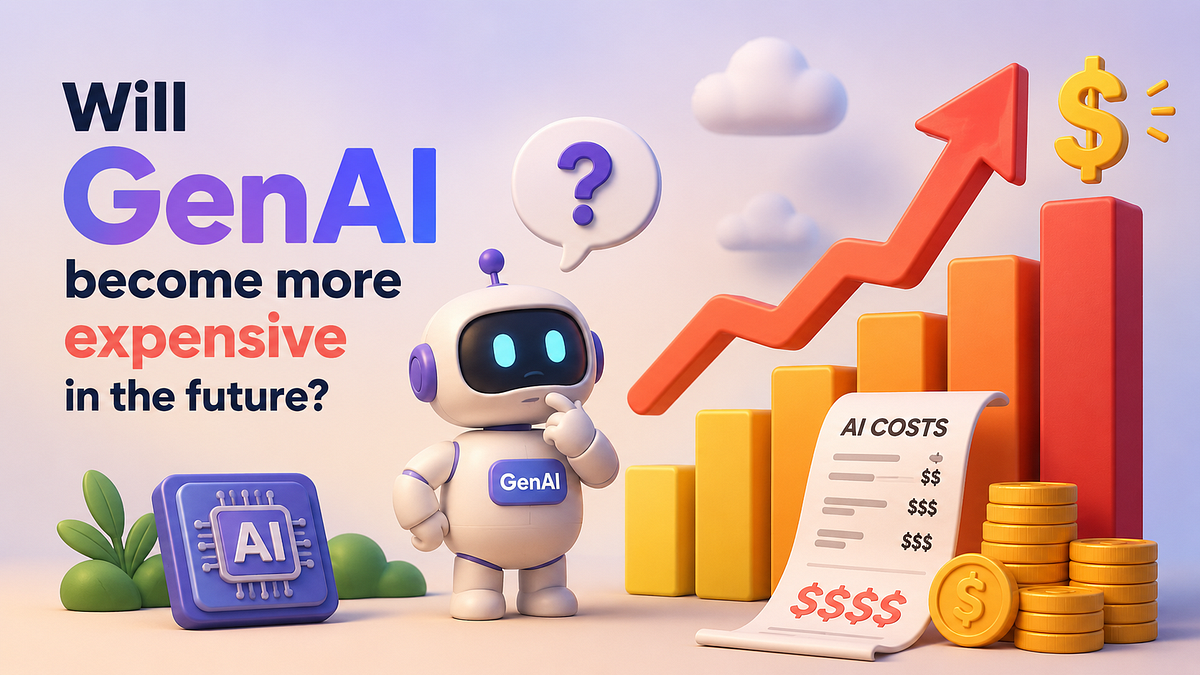
So will GenAI become more expensive in the future?
For basic model access, probably not.
For the work people actually care about in production, the answer is more uncomfortable: routine intelligence will keep getting cheaper, but reliable autonomy will stay expensive enough to meter, bundle and upsell hard.
The market is splitting in two
The cleanest way to think about GenAI pricing is to stop treating it like one market.
It is already two markets.
The first market is commodity inference. That is bulk summarization, classification, autocomplete, first-draft generation, simple support workflows and a lot of “good enough” coding help. Competition is brutal here. Small models keep improving, and open-weight models keep closing the quality gap fast enough that nobody in the hosted market gets to relax. Google, OpenAI and Anthropic all have reasons to keep this layer affordable because cheap usage expands adoption and pulls developers into their ecosystem.
The second market is premium cognition. That is long-horizon reasoning, tool use, coding agents, compliance-heavy workflows, multimodal production work and any task where the buyer cares less about raw token price and more about “Did it actually finish the job without creating a mess?” This layer is where vendors can still charge real money. It uses more inference-time compute, more orchestration and more product surface around the model itself.
That split is already visible in the numbers.
Stanford HAI notes that reasoning systems improved performance sharply in 2024, but also that OpenAI’s o1 was nearly six times more expensive and thirty times slower than GPT-4o. That is the whole story in one sentence. The industry is driving the cost of ordinary intelligence down while preserving a premium for extra thinking time.
What pricing history actually says
If you only remember headlines like “AI is getting cheaper” or “AI is getting more expensive,” the history gets blurry fast. Vendor by vendor, the pattern is clearer.
OpenAI: sharp API deflation, then premium subscription segmentation
- In March 2023, GPT-4 launched at $0.03 per 1K prompt tokens and $0.06 per 1K completion tokens. In today’s per-million framing, that is $30 input and $60 output.
- In November 2023, OpenAI introduced GPT-4 Turbo at $10 input and $30 output per 1M tokens. That was a direct cut.
- By GPT-4.1, OpenAI priced the model at $2 input and $8 output per 1M tokens and said it was 26% less expensive than GPT-4o for median queries.
- On the consumer side, OpenAI did not flatten everything into one cheap plan. ChatGPT Plus stayed at $20 per month, while Pro split upward into $100 and $200 tiers with higher usage and access.
The important pattern is this: OpenAI kept pushing down the cost of mainstream API access while building more ways to charge heavy users, especially the ones who depend on coding, research and high-usage workflows.
That is not contradiction. It is segmentation.
Anthropic: stable Sonnet pricing, then a cheaper high-end Opus
- When Anthropic launched the Claude 3 family in March 2024, Claude 3 Opus cost $15 input and $75 output per million tokens.
- Claude 3.5 Sonnet arrived in June 2024 at $3 input and $15 output per million tokens.
- Claude 3.7 Sonnet kept that same $3 and $15 price in both standard and extended thinking modes.
- Anthropic later revised Claude 3.5 Haiku to $0.80 input and $4 output per million tokens.
- In Anthropic’s current API pricing docs, Claude Opus 4.7 sits at $5 input and $25 output per million tokens, while Sonnet 4.6 remains at $3 and $15.
- On the chat product side, Anthropic’s Max plan now has $100 and $200 monthly tiers.
Anthropic’s history is interesting because it does not support the lazy story that frontier AI must always become more expensive over time. Its newer top-end Opus pricing is materially cheaper than early Claude 3 Opus pricing.
What Anthropic appears to be pricing for is not prestige. It is adoption, then expansion into higher-usage plans and workflow products like Claude Code.
Google: aggressive cuts, then subscription bundling
- In August 2024, Google cut Gemini 1.5 Flash pricing by 78% on input and 71% on output, bringing it to $0.075 input and $0.30 output per million tokens for prompts under 128K.
- In September 2024, Google cut Gemini 1.5 Pro pricing by 64% on input and 52% on output for prompts under 128K.
- In Google’s current Gemini Developer API pricing, Gemini 3.5 Flash is listed at $1.50 input and $9.00 output per million tokens, while Gemini 3.1 Flash-Lite is much cheaper at $0.25 input and $1.50 output.
- On the consumer side, Google launched Google AI Ultra in May 2025 at $249.99 per month in the US.
- In May 2026, Google introduced a new $100 AI Ultra plan and cut the previous top-tier Ultra plan from $250 to $200 while keeping the same capabilities.
Google is running the clearest bundle strategy of the three. It cuts API prices hard, then tries to capture value by packaging Gemini into a broader ecosystem of apps, storage, creative tools and developer workflows.
That matters because future GenAI pricing will not live only inside raw token math. It will live inside bundles, quotas, priority access and ecosystem gravity.
The economic war is not just about cheaper tokens
People keep talking about an “AI war” as if it is a single race for the smartest model. It is not. It is at least three economic wars happening at once.
1. The commodity inference war
This is the layer where every vendor wants to become the default utility.
If you are pricing a mid-tier model for summarization, drafting, retrieval cleanup, or everyday coding help, being 20% cheaper matters. Being 3x cheaper can redraw the market. OpenAI, Google and Anthropic have all shown a willingness to drive prices down here because the goal is not only immediate margin. The goal is to become the model a team integrates first.
Once you are first, you get the traffic, the prompt history, the switching costs and eventually the chance to sell something more expensive.
2. The premium reasoning war
This is where price cuts stop being the whole story.
Reasoning models burn more compute at inference time. Stanford’s AI Index makes that explicit. If a model thinks longer, iterates more, or runs richer tool chains, the vendor has a much better case for charging more or rate-limiting more aggressively. The model may still be “cheaper per token” on paper than its predecessor while being more expensive per completed task in practice because the workflow surrounding it is heavier.
That is why the future pricing fight will not be about a single list price. It will be about who can sell premium reliability without making buyers feel fleeced.
3. The distribution and lock-in war
This is the least discussed layer and probably the most important one.
OpenAI is not only selling models. It is selling ChatGPT as a work surface, Codex as a coding surface and higher tiers as a way to remove friction for power users. Anthropic is doing the same with Claude, Claude Code and Max. Google is embedding Gemini into its productivity, media and developer ecosystem.
The winner here does not need the absolute cheapest model.
The winner needs the workflow people stop wanting to leave.
Why a cheaper model can still create a bigger bill
This is where a lot of teams fool themselves.
They compare price per million tokens from one quarter to the next, see a downward move and assume the financial trend is good. Then the monthly invoice lands and nobody understands why spend went up.
Usually it happened for one of four reasons.
- The lower unit price increased demand.
When usage gets cheaper, teams stop rationing it. More features ship, more internal tools appear and quiet background jobs start calling the model too. The model is no longer a special event. It becomes plumbing. - The workflow got deeper.
A single answer turns into retrieval, re-ranking, tool calls, code execution, retries, validation and post-processing. The model call is no longer the whole product. It is the center of a more expensive loop. - The buyer moved upmarket.
Teams start on the cheap model, hit quality limits, then route hard cases to a stronger one. This is rational. It also means the average cost per accepted output often rises even when the cheapest tier keeps getting cheaper. - The vendor moved value into the bundle.
Priority access, desktop apps, coding agents, storage, research tools, connectors and team features change what the customer is really paying for. A token line item can fall while total platform spend rises.
OpenAI’s GDPval page is useful here because it makes an important distinction. OpenAI says frontier models can complete GDPval tasks roughly 100x faster and 100x cheaper than industry experts, but it also says those figures only reflect pure inference time and API billing. They do not include the human oversight, iteration and integration work needed in real workflows.
That caveat matters. A lot.
Cheap inference is not the same thing as cheap adoption.
My prediction: GenAI gets cheaper at the bottom and more expensive at the top
Based on the pricing history so far, this is the most likely path.
Basic text and code assistance will keep getting cheaper. Fast models, smaller models and open-weight alternatives will keep pressuring the floor. Stanford’s AI Index already shows why: the cost curve for “good enough” intelligence has been collapsing, and open-weight models narrowed the gap with closed models from 8.04% to 1.70% on some leaderboards in about a year.
Premium reasoning will stay expensive enough to meter. It may not always look expensive in the same way. Sometimes it will be a higher token price. Sometimes it will be a higher usage tier. Sometimes it will be a slower model with better outcomes. Sometimes it will be hidden inside an agent subscription. But the premium will remain.
Enterprise AI spend will concentrate around workflow ownership, not only model quality. The vendors that control search, files, connectors, IDE integration, compliance and admin tooling will have more room to charge because they are selling reduced operational friction, not just raw generation.
The average developer will probably see a strange mix of falling and rising costs at the same time:
- Casual usage gets cheaper.
- Heavy usage usually does not.
- Prototypes get cheaper.
- Production governance often refuses to.
- A single call gets cheaper.
- The end-to-end system bill can still climb.
That is why the future of GenAI pricing looks less like one line moving up or down and more like a fork in the road.
If AI gets expensive, will developers actually lose their jobs?
Some will lose parts of their job before they lose the whole job. That distinction matters more than people admit.
The World Economic Forum’s Future of Jobs Report 2025 says employers expect 170 million new roles and 92 million displaced roles by 2030 for a net gain of 78 million jobs. The same report says 41% of employers plan to reduce their workforce where AI can automate certain tasks, yet 77% plan to upskill workers and software and applications developers still sit among the fastest-growing roles.
That is not a comforting slogan. It is a messy labor market signal.
The risk is not “all developers disappear.” The risk is that routine, well-specified, entry-level coding work keeps losing pricing power. Expensive AI might slow that pressure a bit, but it does not reverse the direction. If a team has already redesigned its workflow around AI-assisted review, test generation, scaffolding and search, a higher bill does not automatically create fresh demand for the same old junior tasks.
It usually creates a new management question instead:
Which parts of the work deserve premium AI spend, and which parts should be routed to cheaper models or done manually?
That is not the same as jobs coming back untouched.
If AI gets expensive, do developers get their “normal job” back?
Mostly no. Some habits come back. The old job shape does not.
Once a team learns that a model can summarize logs, draft test cases, search a large codebase, or explain a dependency chain in seconds, it rarely chooses to forget that. If premium AI gets too expensive, the usual reaction is substitution, not reversal.
Teams substitute in three directions:
- Sometimes they downgrade to cheaper hosted models for simpler tasks.
- Open or local models take over where privacy or cost dominates.
- Premium models get reserved for the hard path: design reviews, thorny bug hunts, migrations, or compliance-heavy work.
So the likely future is not “everybody stops depending on AI and returns to 2022.”
The likelier future is “everybody becomes much more selective about where premium AI is worth paying for.”
That is a very different world from both the hype case and the backlash case.
Will developers become dependent on AI?
Yes. The only real question is what kind of dependence they build.
Anthropic’s software development research already shows that coding workflows are moving beyond casual chatbot use. In its analysis, 79% of Claude Code conversations involved some form of automation, versus 49% on Claude.ai. That is a meaningful shift from “help me think” to “help me execute.”
There are two versions of that dependence.
Healthy dependence
- Use AI to compress search time.
- Draft, compare, summarize and unblock faster.
- You still understand the code, the system and the trade-off.
- A vendor swap does not wreck your engineering judgment.
Dangerous dependence
- You stop building mental models.
- Review gets lazy because the model is “usually right.”
- Your team’s speed depends on one premium vendor and one expensive tier.
- Nobody remembers how to reason through the hard parts without an assistant.
The dangerous version is the one that gets exposed when prices rise, quotas tighten, or model behavior shifts.
The developer who is safest in that world is not the developer who rejects AI.
It is the developer who can use AI aggressively without outsourcing judgment to it.
What engineers should do now
If you believe GenAI could get more expensive where it counts, there are a few practical moves that matter.
Build a model portfolio, not a model religion
Use cheap models for cheap work. Reserve expensive models for expensive mistakes. Teams that route everything through one premium model usually discover too late that they were paying for certainty on tasks that never needed it.
Track cost per accepted outcome
Token cost is a misleading metric on its own. Measure cost per merged PR, resolved support case, approved summary, or successful workflow run. That is the only unit your finance team will care about once experimentation turns into budget.
Keep review skill brutally sharp
If AI becomes a normal layer of engineering, review becomes more valuable, not less. The people who can spot hidden risk, weak reasoning and incorrect assumptions will stay expensive in the labor market even if token prices collapse.
Avoid product lock-in disguised as convenience
Convenience matters, and exit cost matters more than most teams notice because they only feel it after one vendor becomes mandatory for basic output. That is the moment your pricing risk jumps. Keep prompts portable where possible, keep evaluation datasets and keep fallback paths.
Expect price drops and price extraction at the same time
That is the new normal. Budget for both.
So, will GenAI become more expensive?
For basic access, probably not. History points the other way.
For premium reasoning, agentic execution and the workflows teams end up depending on, very possibly yes.
Cheap intelligence is becoming infrastructure. Expensive autonomy is becoming the product. The developers who understand that split will adapt faster than the ones waiting for the market to move in only one direction.

This story is published on Generative AI. Connect with us on LinkedIn and follow Zeniteq to stay in the loop with the latest AI stories.
Subscribe to our newsletter and YouTube channel to stay updated with the latest news and updates on generative AI. Let’s shape the future of AI together!