Good code is not the bar. Bounded permissions, verification and rollback ownership are.
The easiest way to misunderstand coding agents is to judge them by the wrong success signal.
The pull request looks clean.
The tests passed.
The diff is smaller than you expected.
That still does not tell you whether the agent was safe to use.
Safe is not the same thing as impressive. Safe is not “the code worked on the first try.” Safe is not even “the agent wrote something I would have written.” A coding agent is safe when the blast radius is bounded before it starts, the evidence is reviewable when it finishes, and one human still owns the decision to let that code get anywhere near production.
That sounds stricter than a lot of AI demos. It is. Work code deserves stricter rules than demos.
Most of the public conversation around coding agents is still stuck on the fun part: they can open pull requests, explore repositories, run tests, fix bugs, and work in parallel. All true. OpenAI’s Codex runs each task in an isolated environment, can run test harnesses and linters, and gives you citations of terminal logs and test outputs. GitHub Copilot cloud agent works in its own ephemeral GitHub Actions environment and can run automated tests and linters before it opens a pull request. Anthropic’s Claude Code defaults to read-only access and asks for explicit permission before it edits files, runs tests, or executes commands.
If you read the vendor docs carefully, they are all telling you the same thing in slightly different accents.
The agent is not supposed to be trusted because it is smart.
It is supposed to be usable because the environment around it is constrained.
Good code is not the standard
This is the first mental reset teams need.
People often ask whether an agent writes “good enough code.” That is a quality question. Safety starts earlier.
A junior engineer can write excellent code in an unsafe process. A senior engineer can approve a correct change in an unsafe process. An agent can absolutely produce a passing patch in an unsafe process. The danger is not only bad output. The danger is unbounded output, weak review, invisible side effects, and no clear human owner when the change collides with reality.
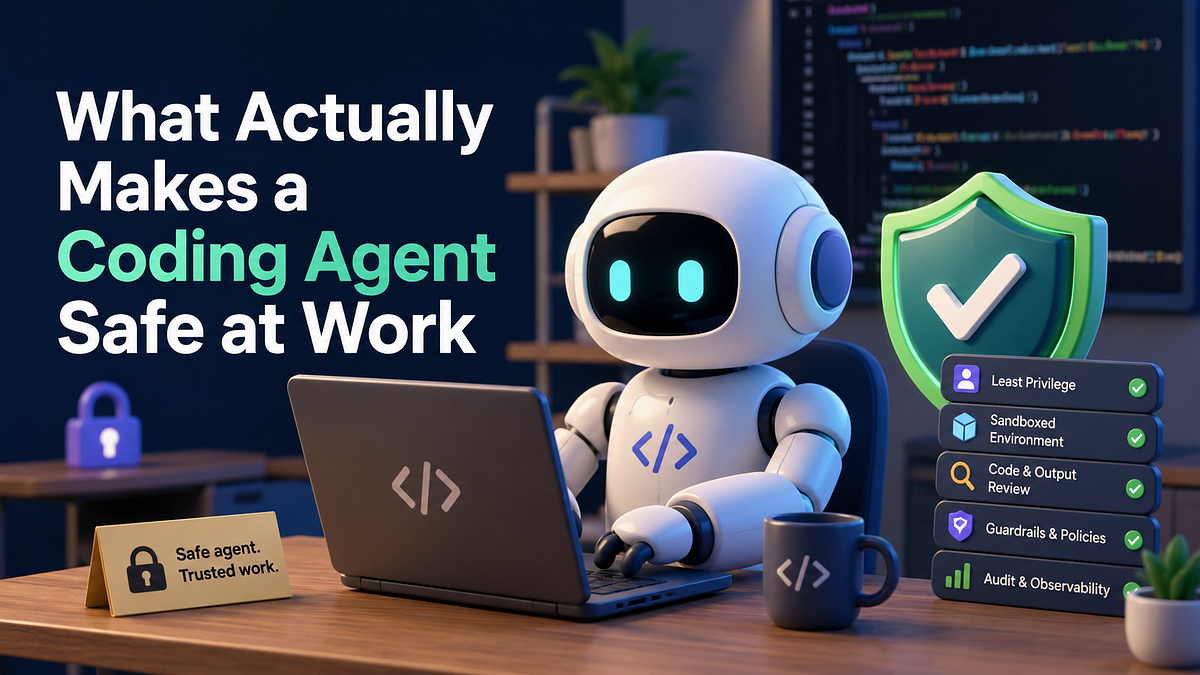
So when I say a coding agent is safe to use at work, I mean four things:
1. Its permissions are deliberately narrow
- The agent can only touch the repo, branch, services and commands you meant it to touch.
- It does not quietly inherit broader access because nobody bothered to fence it in.
2. It can verify its own work before a human spends review time
- Tests, linters, or type checks run before the pull request becomes somebody else’s problem.
- If the agent cannot produce evidence, the task is not ready for human review.
3. Its actions are traceable
- You can see what it ran, what changed, and what assumptions it made.
- If a reviewer has to reconstruct the whole session from vibes, the workflow is already too loose.
4. A human owns the rollback decision
- Not the prompt author.
- Not “the team” in the abstract.
- One real person who would know what to do if the change breaks something ugly late on a Friday afternoon.
That is the standard, and it has very little to do with style, speed, or whether the agent feels magical on a screen recording.
What the vendor docs quietly agree on
This is the part I find reassuring, actually.
The marketing pages show the autonomy, while the product docs show the guardrails that make that autonomy usable in the first place.
OpenAI Codex
- Codex runs each task in its own isolated cloud environment.
- It can run test harnesses, linters and type checkers while it works.
- OpenAI says users should verify its actions through terminal logs and test outputs, and still manually review the resulting code before integration.
That is not “just trust the agent.” It is “trust the agent inside a workflow that leaves evidence.”
GitHub Copilot cloud agent
- Copilot works in an ephemeral GitHub Actions-powered environment.
- GitHub limits where it can push, who can trigger it, and when its workflow runs are allowed to execute.
- GitHub’s own docs say pull requests raised by the agent still require human approval before those workflows run.
Again, the pattern is obvious once you stop looking for hype.
Autonomy goes up, but so does containment.
Anthropic Claude Code
- Claude Code starts with read-only permissions by default.
- It asks for explicit permission before editing files, running tests, or executing commands.
- Anthropic’s security docs also lean hard on sandboxing, write-scope restrictions, and prompt-injection protections.
That is a safety story, not a convenience story.
AWS AI-DLC
- AWS frames AI-driven development around “critical human oversight and collaboration.”
- Their claim is not that AI removes quality work. It is that AI changes where humans spend it.
That is the honest version.
None of these systems are saying, “The model is good now, so governance is optional.” They are saying the exact opposite if you read past the product launch excitement. They are trying to make autonomous behavior survivable inside a real engineering workflow.
The shortest useful definition of agent safety
Here is the definition I would actually hand to a team:
A coding agent is safe when failure is cheap, review is evidence-based, and production authority still belongs to a human.
Cheap failure matters because agents are fast. Fast systems can do a lot of damage politely.
Evidence-based review matters because code generation is no longer the scarce part. Reviewer attention is. If the reviewer has to read 600 lines of AI output without test evidence, command logs, or a clear plan, the workflow is upside down. The expensive human is doing archaeology while the cheap machine already had its turn.
Human production authority matters because somebody still has to understand the cost of being wrong. That cost is not evenly distributed. A broken side project is annoying. A broken billing flow, auth path, deployment script, or data migration has a very different personality once customers get involved.
Which is why I do not think “the agent opened a good PR” is the right question.
The right question is: what was the maximum thing this agent could have broken before a human intervened?
That question is much more useful. Also much less flattering.
Three signs your agent workflow is unsafe
These show up earlier than people expect.
1. The agent can do more than the reviewer can quickly validate
This is the most common failure mode.
The agent explores, edits, runs a few checks, and opens a PR across enough files that the reviewer starts squinting instead of reasoning. At that point, the machine is no longer reducing cognitive load. It is exporting it.
If one reviewer cannot understand the change in one sitting, you do not have safe delegation. You have throughput that escaped containment.
2. “Passed tests” is doing all the rhetorical work
Tests are necessary. They are not a moral certificate.
An unsafe workflow often hides behind one green check. The problem is not that tests ran. The problem is that nobody asked whether the tests were the right tests, whether the agent wrote them to satisfy the implementation it had already chosen, or whether any meaningful behavior outside that narrow path was actually exercised.
Passing checks are evidence. They are not judgment.
3. Nobody can name the rollback owner
This one sounds procedural until it hurts.
If the agent generated the code, one engineer wrote the prompt, another clicked approve, and nobody clearly owns the deployment consequence, then the workflow is only safe while nothing surprising happens. Which is not much of a safety definition.
One human must own the “we ship this” decision. One. Not a blur of shared enthusiasm.
The practical checklist I would use
If you want something a team can actually use next week, use this.
Before letting a coding agent work on a task, ask:
- Can the task be bounded?
One repo, one branch, one service area, one rollback story. If not, the task is too loose. - Can the output be verified automatically?
If you do not know which tests, checks, or assertions should run, the human should stay in front longer. - Would a bad answer be expensive?
Billing, permissions, production data, auth, infra changes, migrations. Slow down. - Will the reviewer get evidence or just code?
Logs, tests, plan, assumptions, changed files. The review package matters. - Who owns the rollback?
If that answer is fuzzy, the delegation decision is premature.
If you can answer all five cleanly, the task is probably a good candidate for agent help. If two or three answers are vague, keep the agent in a narrower lane.
That lane can still be valuable, by the way.
This is where teams get too dramatic. “Unsafe for autonomy” does not mean “useless.” It might mean the agent should propose a plan, generate tests, or produce a draft patch while a human still drives the higher-risk decisions, which is not failure at all. It is a sane division of labor.
A better way to split the work
I think small teams should stop talking about agent usage in binary terms.
Not:
- we use coding agents
- we do not use coding agents
That framing is too crude.
The better split is:
Agent-first
- low-risk refactors
- test generation in well-understood modules
- documentation updates
- logging improvements
Agent-assisted
- medium-risk feature work with strong acceptance criteria
- bug fixes that are reproducible and easy to validate
- code cleanup where the behavior is already clear
Human-first
- auth changes
- billing behavior
- production migrations
- ambiguous feature design
- anything where the rollback story is ugly
That list is not ideology. It is queue design.
You are deciding where autonomy saves time and where autonomy simply makes mistakes faster. Those are not the same thing. They only look the same when the workflow is still new and everyone is excited.
The part most teams discover late
The real safety layer is not the model. It is the operating model around the model.
That is why the most useful agent features are rarely the flashy ones. The useful features are the boring ones:
- isolated task environments
- explicit permissions
- test execution
- branch limits
- review gates
- session logs
- sandbox boundaries
Those controls do not make a keynote demo more exciting. They make an engineering team less fragile.
I would even go a step further.
If a coding agent workflow does not leave behind a package of evidence a tired senior engineer can review quickly, I do not think it is ready for work use yet, no matter how impressive the code looks. Fast generation without fast validation just moves the bottleneck into a more expensive person’s head.
And that bottleneck gets grumpy.
What I would trust tomorrow
I would trust a coding agent to touch real work tomorrow if the workflow looked like this:
- The task is narrow.
- The environment is isolated.
- The permissions are explicit.
- The verification steps are known before execution starts.
- The resulting changes come with logs, test evidence, and a human reviewer who owns the decision.
I would not trust a workflow that says:
- give the agent broad repo access
- let it figure out the checks
- open a giant PR
- assume the reviewer will catch anything weird
That is not an agent strategy. That is wishful thinking with better tooling.
The teams that get the most value from coding agents will not be the ones who worship autonomy. They will be the ones who make autonomy legible, reviewable and cheap to stop when it goes off course.
That is what makes a coding agent safe at work.