Code gets cheaper first. Judgment does not.
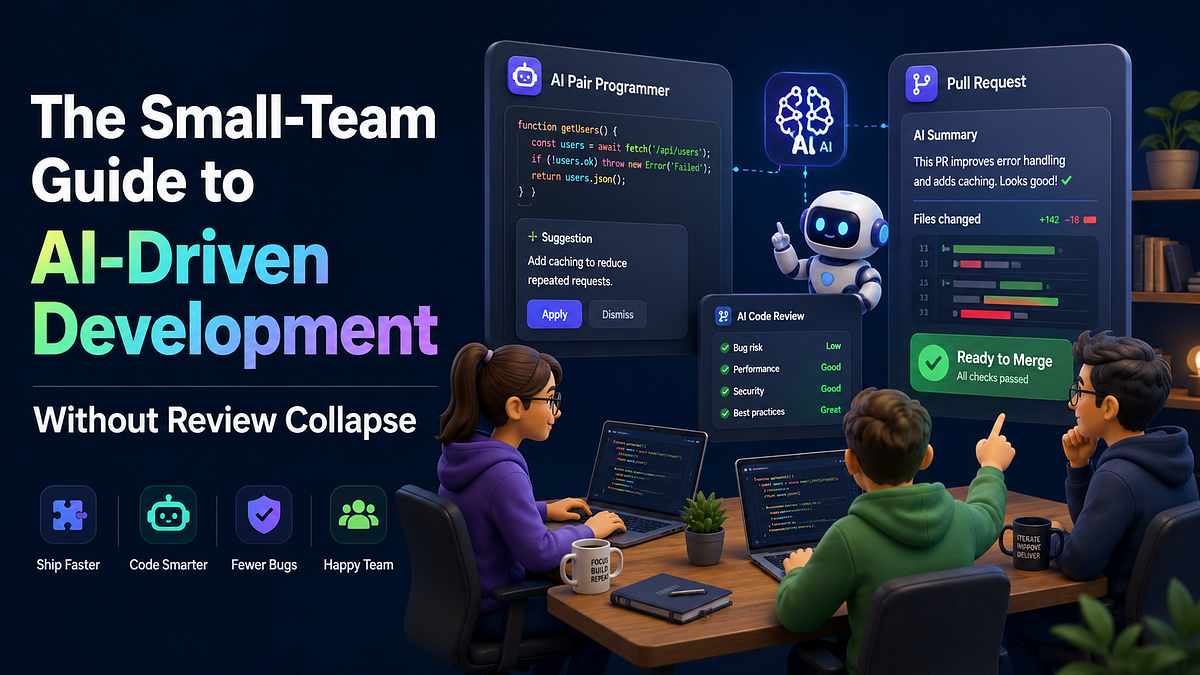
AI-driven development (AIDD) sounds simple when you only look at the typing.
The model writes code, the team moves faster and everyone wins. That is the promise.
That story lasts right up until the week your small team starts producing more pull requests, more half-validated changes and more “can you just take a quick look?” pings than your most senior engineer can absorb without quietly becoming the system bottleneck.
That is the part many teams are only discovering now.
The tooling is real. GitHub says its cloud agent gets an ephemeral GitHub Actions environment where it can explore the repo, make changes and run tests and linters. OpenAI says Codex runs tasks in separate cloud sandboxes, can work on many tasks in parallel and gives users citations, terminal logs plus test results. Anthropic describes Claude Code as an agentic coding environment that can read files, run commands, make changes and scale across parallel sessions.
In other words, the vendors are not selling autocomplete anymore. They are selling workflow participation.
That changes the job of a technical lead.
If AI can generate implementation faster than your team can review, validate and integrate it, then AIDD is not mainly a coding problem. It is an operating model problem.
AIDD is not “developers using AI sometimes”
This distinction matters more than it sounds.
A team using AI occasionally is still doing normal software development with a new helper. AIDD starts when the team begins designing work around the assumption that agents will participate throughout the lifecycle.
That includes things like:
- drafting implementation plans before a human writes code
- generating tests in parallel with features
- delegating bug isolation to background agents
- using AI to review diffs before humans do
- splitting one feature into multiple agent-sized work packets
Once that becomes the normal path, your team is not just “trying AI tools.” You are running an AI-shaped development process.
JetBrains’ January 2026 AI Pulse survey is useful here because it shows both how far the shift has gone and how incomplete it still is. Their March 2026 write-up says 90% of developers already use AI at work, 22% already use AI coding agents and 66% of companies surveyed plan to adopt coding agents within the next 12 months. But the same source says no more than 13% of developers use AI across the full software development lifecycle, including code review or release pipelines.
That gap is the whole story.
Most teams already have AI in the room. Very few have rebuilt the room around it.
The first bottleneck AIDD removes is not the important one
Typing was never the hardest part of software delivery for most senior teams.
It was visible, yes. It was easy to count, yes. It was also only one stage in a chain that already included scope definition, architecture, validation, review, release management, rollback planning and all the dull but expensive conversations nobody includes in productivity screenshots.
AI makes one part of that chain much cheaper.
Not all of it.
This is why so many teams feel a weird mix of acceleration and drag at the same time. Individual contributors can produce more candidate changes. But the shared systems around those changes still move at human speed:
- someone still has to decide whether the right problem is being solved
- someone still has to judge whether the change fits the architecture
- someone still has to verify that the tests prove the right thing
- someone still has to decide whether the blast radius is acceptable
The code comes faster. The responsibility does not.
That is why the best way to think about AIDD is not “AI writes code for us now.” The better model is this:
AIDD shifts engineering scarcity away from code production and toward coordination, validation and review.
Once you accept that, the team design gets clearer very quickly.
The real failure mode is not bad code. It is ungoverned throughput.
Bad code is fixable. Ungoverned throughput is sneakier.
You can survive one weak AI-generated function. You can even survive a noisy pull request if the reviewer has time and context. What breaks teams is the compounding effect:
- More code gets proposed per day.
- Review queues grow faster than context can be transferred.
- Senior engineers become approval routers instead of builders.
- Small issues get deferred because “the AI can clean them up later.”
- Nobody notices that verification quality is slipping until production says hello.
This is where a lot of AIDD discussions go soft. They tell teams to be careful. That is true and not very useful.
Small teams need operating rules, not vibes.
Here is the rule I would start with:
Do not measure AIDD success by code volume. Measure it by verified changes that safely ship.
If AI doubles code output but also doubles review delay, rollback risk, or senior fatigue, your process did not improve. It just got louder.
What a workable AIDD model looks like on a small team
This is the part people usually skip and jump straight to tool recommendations. I think that is backwards.
Before choosing a preferred agent, decide how work will flow.
Rule 1: Start every non-trivial task with an artifact, not a prompt
In AIDD, prompts are too disposable to be the main container for intent.
Anthropic’s Claude Code best practices make this point indirectly. Their docs emphasize giving the agent a way to verify its work and show how teams scale with separate parallel sessions rather than one giant all-purpose conversation. That guidance exists for a reason: once an agent is allowed to act, ambiguous intent multiplies quickly.
For a small team, the minimum useful artifact is usually one of these:
- a task brief with constraints
- a checklist of acceptance criteria
- a rough implementation plan
- a failing test or reproducible bug report
The artifact does two jobs:
- it tells the agent what “done” means
- it gives the reviewer something more stable than a clever prompt transcript
Without that artifact, every review starts from archaeology.
Rule 2: Put a review budget on every AI-generated change
This is the missing practice in most teams.
Human review is scarce. Treat it like budget.
If your team lets agents produce arbitrarily large diffs because “the machine did most of the work,” you are creating the exact conditions where reviewers stop reasoning and start skimming.
A practical review budget can be simple:
Low-risk lane
- naming cleanup
- test generation on well-understood modules
- lint or type fixes
- small refactors with strong test coverage
High-risk lane
- auth flows
- billing logic
- data migrations
- concurrency
- anything with unclear rollback behavior
The point is not bureaucracy. The point is matching review depth to risk before the code exists, not after the diff scares someone.
For small teams, I would also cap AI-generated PR size aggressively. If a change is too large for one reviewer to understand in one sitting, it is too large to merge comfortably just because the agent assembled it fast.
Rule 3: Require verification that the agent can run before humans spend review time
Anthropic’s docs say giving the agent a way to verify its work is the highest-leverage thing you can do. That matches what I have seen in practice. The fastest way to waste senior attention is to send them code the model could have invalidated itself.
Before human review begins, ask:
- Did the agent run the relevant tests?
- Did it lint or typecheck the change?
- Did it compare against expected output, screenshots, or failing cases where that matters?
- Did it leave evidence behind that another human can inspect quickly?
OpenAI makes a similar point in how it positions Codex. The product returns citations of terminal logs and test outputs because proof matters. AIDD becomes much more usable when reviewers inspect evidence first and code second.
This sounds obvious. It is not how many teams behave.
They ask the agent to “build the feature” and send whatever comes back into the same review lane humans used before. That wastes the machine’s main advantage, which is cheap iteration before a human gets involved.
Rule 4: Separate orchestration from implementation ownership
One of the stranger things AIDD does to small teams is blur who actually owns the shape of a change.
The agent may write the code while the lead defines the constraints and another engineer reviews it. A product manager may even trigger the first draft if your toolchain allows that. If nobody is explicitly accountable for integration quality, the team starts shipping a lot of code that technically belongs to everyone and operationally belongs to no one.
So pick an owner for each change. One human only, always.
That owner is responsible for:
- whether the agent got the right context
- whether the change was split correctly
- whether the validation is strong enough
- whether the final merged behavior matches the team’s intent
AIDD works much better when orchestration is treated as real engineering work, not as a lightweight management wrapper around code generation.
A useful decision framework for small teams
If you are trying to adopt AIDD without creating review collapse, use this filter before handing work to an agent:
Use AIDD heavily when
- The success criteria are easy to state.
- The codebase area is already well understood.
- Validation can be automated cheaply.
- The rollback path is boring.
Use AIDD carefully when
- The task crosses multiple domains.
- The agent needs hidden business context to make trade-offs.
- The validation relies on human judgment or production knowledge.
- The failure mode is expensive even if the diff looks clean.
Keep the human in front when
- You are still deciding what the feature actually is.
- Architecture is still moving.
- The problem is mostly stakeholder ambiguity dressed up as implementation work.
- The team would struggle to explain why the change is safe without reading the entire diff line by line.
That last one matters. A lot.
AI is very good at making incomplete thinking look complete.
The small-team version of AIDD is mostly queue design
This is the most important shift to understand.
On a small team, you are not building an AI factory. You are designing queues:
- a queue of work waiting for clearer specification
- a queue of changes waiting for automated verification
- a queue of diffs waiting for human review
- a queue of merged changes waiting for observation in production
If you ignore those queues, AIDD just floods them faster.
If you design around them, AIDD becomes useful.
That means your best investments are often not “which model should we buy next?” They are quieter than that:
- better test coverage in the modules agents touch most
- better templates for task briefs and acceptance criteria
- better PR splitting habits
- better CI signals
- better rules about when not to delegate
JetBrains’ May 2026 post on review friction describes the dominant organizational pattern as ad hoc: developers use AI tools however they like with little governance from above. That is exactly the stage many teams are in. It feels empowering at first because everyone can move independently. Then the downstream queues remind you that independence and coordination are not the same thing.
What to change first if your team is already feeling the pain
Do not start with a giant AI policy deck. Start with these four moves:
- Write down your review lanes.
- Cap AI-generated PR size.
- Require machine-verifiable evidence before human review.
- Make one person accountable for each agent-assisted change.
That alone will fix more than another month of prompt tweaking.
Then, once the flow is stable, improve the infrastructure around it:
- strengthen test suites in high-change areas
- create reusable task templates
- decide which work is agent-friendly by default
- track review time, not just output volume
This is less exciting than talking about autonomous software teams. It is also how small teams stay sane.
AIDD works best when it makes judgment more visible
The best outcome of AI-driven development is not that humans disappear from the loop.
It is that the loop gets clarified.
When code becomes cheap, the expensive parts of engineering stop hiding:
- understanding the real problem
- choosing the trade-off
- proving the change is safe
- deciding what deserves to ship
That is why I think AIDD is real and also why I think many teams are adopting it in the wrong order. They buy generation first and design governance later. Small teams should reverse that instinct.
Build the review model first. Then let the agents run inside it.
Otherwise you are not doing AI-driven development. You are just speeding up the part that was easiest to accelerate.