Most of the engineers say it’s their biggest frustration at work. It’s probably not on your roadmap.
You approved 12 features this quarter. Eight shipped.
The team worked the same hours and nobody was slacking. The standups happened on schedule, every single one. And yet the roadmap slipped by four items with no dramatic incident, no obvious bottleneck and a lot of vague explanations about complexity that made perfect sense in the moment and added up to nothing useful.
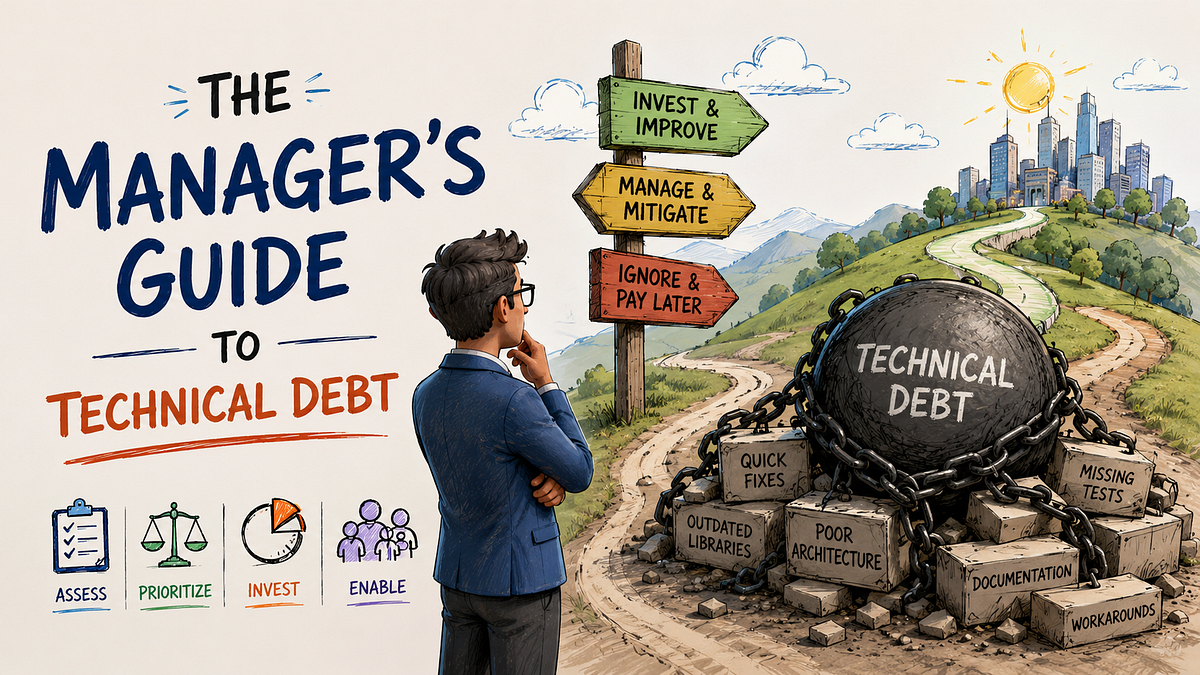
What ate those four features is almost certainly technical debt. Not because engineers are bad at estimating. Because technical debt is a tax running in the background on every piece of work your team does and most managers never see the invoice.
Ward Cunningham coined the term in 1992 at the OOPSLA conference in Vancouver. He described code shipped before it was fully understood as being like borrowing money. The principal is the work you skipped. The interest is every future task that takes longer because of what you skipped it in.
That metaphor is thirty-three years old. It still describes most engineering teams accurately.
What Technical Debt Is Not
A correction that will save you several frustrating conversations: technical debt is not the same as legacy code. Legacy code is old. Technical debt is a structural decision made at any point in time.
A system built six months ago with the wrong architecture already carries more debt than a five-year-old system designed thoughtfully and maintained consistently. The age of the code is irrelevant. The quality of the trade-offs made during its creation is everything.
Technical debt is also not a synonym for “messy code” or “code I don’t like.” Engineers sometimes use it as a catch-all for any work they find unpleasant. That does not help you make decisions. Precise language does.
The working definition: a gap between what the code does and what it should do given current understanding, where that gap has been deferred intentionally or not.
The Quadrant Your Engineers Know but Probably Haven’t Shown You
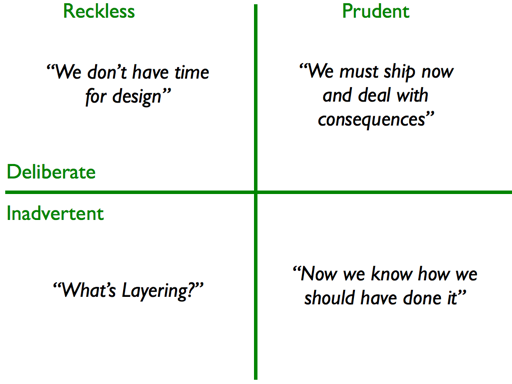
Martin Fowler formalized a framework for categorizing technical debt that most senior engineers know and almost never share with their managers. It maps debt on two axes: how deliberate the decision was and how well-reasoned it was.
Reckless and Deliberate The team knew they were taking a shortcut and did it anyway without analysis. “We don’t have time for design.” No upside exists here. This is the only category that represents genuine dysfunction.
Reckless and Inadvertent The team wrote poor code without realizing it. Usually a skills gap, or a team that was never given time to learn. The debt accumulated silently. The solution is investment in capability, not blame.
Prudent and Deliberate The team chose to ship something incomplete on purpose, with full awareness of the trade-off. “We’ll ship this simplified version now and refactor after launch.” This is a legitimate business decision. It should be documented, tracked and paid back. It often is not.
Prudent and Inadvertent The team built something good, then learned something new that made the original design look naive. This is normal. Understanding a problem well enough to design it correctly usually requires building it first. You cannot prevent this category from existing.
The insight: only one of these four represents poor engineering culture. The others are either unavoidable or a valid tool. Managers who treat all technical debt as a failure create incentives for engineers to hide it rather than surface it. That makes everything worse.
Where It Actually Lives
Technical debt is not only in the code. It accumulates in eight places that matter for a business.
Architecture debt — most expensive
It is baked into how the system is structured. Fixing it means restructuring parts of the system, not just editing files. This is why some features that look simple from the outside take a quarter instead of a sprint.
Code debt — visible kind
Duplicated logic, unclear naming, functions that do six things at once. A high-debt codebase is slower to change and harder to debug. New engineers need longer to become productive in it.
Test debt — coverage that was skipped.
Every feature built on untested foundations risks breaking something unexpected. Teams with high test debt slow down as the system grows because every change requires manual verification of things that should be automated.
Documentation debt
This debt is the gap between what is written down and what is actually true. When the engineer who built a system leaves, undocumented systems become archaeology projects. (This is less dramatic than it sounds and also more expensive than it sounds.)
Infrastructure debt
This debt is like the database version that has not been upgraded in three years. The server configuration that works but nobody fully understands. The deployment process held together with scripts written under pressure during an incident two years ago.
Process debt
This debt is the manual steps that were meant to be automated. The release checklist that is still a Google Doc. The onboarding process that only works if a senior engineer explains it verbally.
Defect debt
This debt is known bugs that have been deprioritized. They sit in the backlog while new features are built on top of broken behavior.
Design debt
Accumulates when the user experience and system interactions are patched rather than designed. Screens added without following an established pattern, flows that contradict each other across versions, component inconsistencies that make the product feel fragile. It is invisible until a new team member tries to extend the product and cannot figure out what rules they should follow.
Build debt
The CI/CD pipeline that takes 40 minutes when it should take 8, the flaky tests that fail randomly so engineers have started ignoring them, the release process that requires three people to coordinate manually. Every hour engineers spend waiting for builds or untangling release steps is an hour not spent on your roadmap.
Requirement debt
This debt is the gap between what was actually needed and what was built because the requirements were not clear when work started. Features that technically work but solve a slightly different problem. Specifications that were never written down, so the next iteration starts from assumptions instead of decisions.
Service debt
The external dependencies and integrations that have not kept pace with the rest of the system. Third-party APIs running on deprecated versions. Internal services with undocumented contracts that other teams depend on. When something breaks here, nobody is entirely sure who owns it or what it is supposed to do.
Automation debt
The debt that every repetitive task your engineering team still does by hand because automating it was not urgent enough to schedule. Data migrations run manually from a script. Environment setup that requires a two-hour walkthrough. Monitoring alerts configured ad hoc and never consolidated. The time cost is real and recurring.
People debt
The most invisible and often the most expensive category on this list and it rarely shows up in any tool output. Knowledge silos where only one person understands a critical system, with no backup and no documentation, mean that when that person leaves, a routine task becomes a crisis that takes weeks to resolve. This is not a people problem. It is a structural debt your organization accumulated over time by moving fast and never writing things down.
What It Costs
The 2024 Stack Overflow Developer Survey asked over 65,000 developers what frustrated them most at work. Technical debt was the answer for 62% of respondents, placing it twice as high as the second-most-cited frustration.
Three out of five engineers, including yours, are working through something every day that they find genuinely demoralizing and that you probably cannot see on a dashboard.
The business costs land in three places.
Velocity: features take longer than estimated because the team is navigating around existing debt before writing new code. This shows up as sprint after sprint where estimates were “wrong.” The estimates were not wrong. The capacity calculation was.
Security exposure: unpatched dependencies, outdated authentication patterns and undocumented integrations are where most breaches start. Technical debt is not just a productivity problem. It is a risk surface.
Retention: skilled engineers evaluate their environment when deciding whether to stay. A codebase that is structurally improving is worth staying in. One where debt compounds with no relief plan is not. The engineers who leave first are usually the ones with the most options.
Making It Visible
The reason most managers do not know how much technical debt exists is that no one has translated it into terms they work with.
SonarQube is the tool most engineering teams use for this. It runs static analysis across the codebase, identifies code smells, duplications and security issues and outputs a “debt ratio”: the estimated time to fix identified issues as a percentage of the time it took to build the system. Over 7 million developers use it across 35-plus programming languages. CodeClimate does similar work with a maintainability score. If your engineering team runs neither, that is worth asking about.
The useful question to ask your engineering lead is not “how much technical debt do we have?” That has no clean answer. The useful question is: “what is our debt ratio right now and is it trending up or down over the last 90 days?”
A rising ratio with no plan is a risk item. A stable or falling ratio while shipping features means the team is managing it responsibly.
Repaying It
There is no single correct strategy. Four approaches work in different contexts.
- The Boy Scout Rule: leave the code cleaner than you found it, with no dedicated sprints and no rewrites required. The idea is a standing expectation that every code change includes one small improvement to its surroundings: one renamed variable, one extracted function, one test added where there was none. Slow and sustainable, it works best when the engineering culture already values quality over output velocity. Robert C. Martin documented this principle in Clean Code. Simple enough to explain in a sentence and genuinely hard to maintain without deliberate leadership support, because “we’ll clean it up as we go” is exactly the promise that disappears first when schedules tighten.
- Dedicated debt sprints: one sprint in every five focused entirely on debt reduction. Predictable and easy to budget for. The risk is that these sprints become low-priority and get cancelled when product pressure spikes. If your team has tried this and debt sprints keep disappearing from the calendar, the schedule is not the problem.
- The Strangler Fig approach: when replacing a system or component, build the new version alongside the old one and shift traffic to it gradually. Named by Martin Fowler for the tropical fig that wraps around a host tree before replacing it. Works well for architecture debt and legacy system migration. Requires patience, which means it requires budget certainty.
- Controlled prioritization: treat debt as a first-class item in the backlog with severity ratings and an accountable owner. Debt items that affect critical systems get scheduled. Debt that affects nothing important can wait, but “wait” means assigned a future date, not forgotten. This requires your active involvement. Debt items without a manager who will defend their priority do not get scheduled.
What does not work is the “we’ll do it later” promise with no follow-through. Later does not exist in most roadmaps.
AI Has Made This Faster and Worse
AI coding tools generate code that ships fast and accumulates debt at machine speed.
A developer using an AI assistant can produce a working feature in a fraction of the time it would take to build it properly. That is the part everyone talks about. The part nobody is discussing loudly enough is what a fast feature costs the team over the next twelve months in maintenance, debugging and modification time.
The same tools can help on the other side. AI-powered refactoring, automated test generation and code review assistants can accelerate debt reduction. Whether AI is net positive or net negative for your debt ratio depends entirely on whether the code being generated is reviewed by an engineer who understands the system it is entering.
Teams that ship AI-generated code without review are borrowing at a high interest rate. Teams with strong review culture and AI assistance on the tedious parts are getting ahead. The code moves faster in both cases. The outcomes diverge after about six months.
Accept the Inevitable
You will not eliminate technical debt. No team does.
The goal is to own it: know where it is, understand what it costs and make deliberate choices about when to pay it down and when to carry it. The teams that get this right treat debt as a financial instrument. They track it, budget for it and make trade-offs consciously. The teams that pretend it does not exist discover it all at once, usually in the form of a feature that takes three months when it should take three weeks and nobody can explain why without drawing a diagram.