The tables you designed for storing rows are about to be asked to reason about meaning. Most schemas are not built for that conversation.
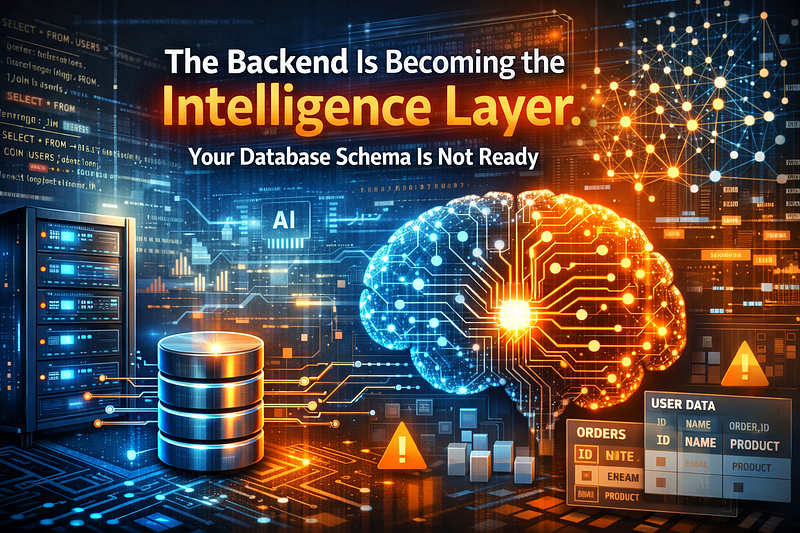
For most of its history, the backend had one job. Store data, retrieve data, enforce relationships between data. The schema was a contract: here are the columns, here are the types, here are the foreign keys. A well-designed schema was predictable, normalised and fast at answering precise questions.
That contract is being rewritten.
In 2026, the backend is no longer just a data layer sitting between a client and a database. It is increasingly the place where meaning gets interpreted, where context gets assembled, where the system understands a request rather than simply matching it to a record. The backend is becoming an intelligence layer, and most of the schemas written over the last decade were not designed with that role in mind.
This is not a distant problem. It is already arriving in the form of product requirements that look deceptively simple: add a search feature that understands what the user means, not just what they typed. Add a recommendation engine. Add a document summarisation pipeline. Add a fraud scoring step to the payment flow. Each of those requirements is asking your backend to do something that a traditional relational schema handles poorly or not at all.
Where Exactly Is the Intelligence? And Why Is It Called That?
This is the question worth pausing on, because “intelligence layer” sounds like marketing language until you understand what it is describing architecturally.
The intelligence does not live in your database. It does not live in your frontend. It lives in the service layer, which is the code that sits between an incoming request and the database query that fulfils it. In a traditional backend, that service layer is thin. It receives a request, validates it, builds a query, returns the result. It is a translator, not a thinker.
In an intelligence layer architecture, the service layer does more:
- It converts the user’s input into a numerical representation of its meaning
- It searches for data that is semantically close to that meaning, not just textually identical to it
- It assembles relevant pieces of content into a structured context
- It may pass that context to a language model to produce a synthesised answer
- It stores the result of that reasoning step alongside the original data
The reason this is called “intelligent” is specific. A traditional query asks: does this row match these conditions? The answer is binary. Either the row matches or it does not. An intelligent query asks: how close in meaning is this content to what the user is looking for? The answer is a spectrum. The system is ranking relevance, not enforcing equality.
That shift from binary matching to ranked understanding is what makes it intelligent. The system is interpreting, not just retrieving.
RAG, or Retrieval-Augmented Generation, is the most talked-about example of this pattern. A user asks a question, the backend retrieves the most relevant documents from its own data, and passes those documents to a language model to generate a grounded answer. But RAG is one implementation. The broader shift includes semantic search, recommendation engines, fraud classification and any feature where the backend needs to understand what something means rather than just where it is stored.
What Your Schema Was Built For
A relational database answers precise questions. It is extraordinarily good at this.
Give it a table of orders, a table of customers and a foreign key between them, and it will return every order placed by a specific customer in under a millisecond. Ask it to find all users older than 30 who joined in the last 90 days and it will execute that without complaint. Relational databases were designed for structured data, exact matches and clearly defined relationships. The B-tree index that underlies most relational query performance is built specifically for this kind of work.
What it was not built for is meaning.
Ask a relational database to find all support tickets that are semantically similar to a complaint about a delayed delivery, even when those tickets use different words, and it will fail. A LIKE '%delayed%' query returns only tickets containing that exact string. It misses every variation: late, held up, not arrived, still waiting. The result is a search experience that frustrates users and a system that cannot reason about its own content.
That gap between exact matching and semantic understanding is precisely where the intelligence layer sits.
Why Embeddings Are the Intelligent Part
This is the concept that makes the whole architecture click, and it deserves a plain explanation.
An embedding is what you get when you convert a piece of text, or an image, or a document, into a list of numbers. Not arbitrary numbers. Numbers that represent the meaning of that content as understood by a machine learning model trained on vast amounts of language.
Here is the key insight: two pieces of content that mean the same thing will produce numbers that are mathematically close to each other, even if they share no words at all.
“The package has not arrived” and “delayed delivery” will produce embedding vectors that are close in distance. “Invoice payment overdue” and “outstanding bill” will be close. “Cancel my subscription” and “I want to stop my plan” will be close. The model learned the relationships between concepts during training and encoded those relationships into the numerical structure of the embeddings.
This is why it is called intelligent. The number is not just a lookup key. It carries meaning. When you search for content similar to a query, you are not matching characters. You are measuring how close in meaning the stored content is to what the user is looking for. The database returns results ranked by conceptual proximity, not string equality.
A standard B-tree index cannot do this. It was designed to answer “is this value equal to or greater than this other value.” It has no concept of semantic distance. To support embedding-based search, you need a different kind of index, specifically one built for high-dimensional vector similarity such as HNSW (Hierarchical Navigable Small World), which is designed to find approximate nearest neighbours across thousands of dimensions quickly.
The embedding column and the vector index together are what give the backend its ability to understand meaning. Without them in your schema, that capability does not exist. You are left with keyword matching and hoping the user phrases their query exactly the way the data was written.
What Changed and Why It Matters Now
The shift has been building for a few years but reached a structural tipping point in 2025. Two things happened that backend developers need to understand.
First, vector capabilities moved from specialised databases into the databases you already run. PostgreSQL added the pgvector and pgvectorscale extensions. MongoDB integrated Atlas Vector Search natively. Oracle released Database 23ai with built-in vector support. SQL Server 2025 introduced the VECTOR data type as a generally available, production-supported feature. In 2025 alone, Snowflake and Databricks spent approximately $1.25 billion acquiring PostgreSQL-first companies. That level of capital does not flow toward a niche technology. It signals that the market has decided vectors are a standard data type, not a specialised tool.
Second, Gartner projected that by 2026, more than 30% of enterprises would adopt vector databases to enrich their systems with relevant business data. The phrase worth paying attention to is “relevant business data.” This is not about research labs or large tech companies building recommendation engines from scratch. It is about mainstream enterprise backends being asked to do semantic work as part of normal operations.
Vectors have moved from being a database category to a data type. The question is no longer whether your backend needs to handle them. It is whether your current schema is ready when the requirement lands.
The Specific Ways Your Schema Falls Short
Understanding why traditional schemas struggle with intelligence workloads requires looking at three concrete failure points.
Exact match versus semantic search. A standard SQL query using LIKE or full-text search returns only keyword matches. A search for “car repair tutorial” will not surface a document titled “vehicle maintenance guide” even though they describe the same thing. Vector search solves this by converting text into embeddings and finding records whose embeddings are mathematically closest to the query. A B-tree index has no concept of distance. You cannot bolt semantic understanding onto a schema designed for exact matches.
The absence of an embedding column. Most existing schemas have no place to store a vector embedding. The column needs to be planned for. The embedding needs to be generated when records are created or updated, requiring a call to an embedding model as part of the write pipeline. The vector index needs to be maintained as data grows. None of this happens automatically, and retrofitting it onto a table with millions of existing rows without a migration strategy is a painful exercise in production database archaeology.
The missing context layer. Intelligence workloads do not just query data. They assemble context. A RAG pipeline, for example, takes a user query, converts it to a vector, retrieves the most relevant content chunks from a vector index, and passes those chunks to a language model as context for generating a grounded answer. The backend is doing five things where it used to do one. Your schema needs to model not just the raw data but also the chunked versions of that data, the embedding representations of those chunks and the metadata needed to filter results before they reach the language model. Most schemas have none of that structure.
The New Backend Responsibilities
The service layer in an intelligence architecture takes on responsibilities that did not exist in the traditional CRUD model. These are worth naming explicitly because they directly change what a schema needs to support.
- Embedding generation and storage. When a document is created or updated, the service layer must generate an embedding and write it alongside the record. This is a new write pattern that most schemas do not accommodate.
- Semantic retrieval. Query paths now include vector similarity searches, often combined with traditional relational filters. Finding the ten support tickets most similar to a query, filtered to the current user’s account and created in the last 30 days, requires both a vector index and standard relational predicates working together.
- Context assembly. For any backend feeding a language model, the system must retrieve relevant chunks, rank them and structure them into a prompt. This is backend logic, not frontend logic. It belongs in the service layer and needs a schema that supports chunked content with metadata.
- Inference result storage. The output of a reasoning step is often worth storing. A fraud score, a classification result, a similarity match. These outputs need a home in the schema with a relationship back to the original record and a timestamp so you can track when the inference was run and against which model version.
- Model version awareness. Embeddings generated by different models are not interchangeable. A schema that stores embeddings without recording which model produced them will cause subtle and difficult-to-debug retrieval errors when the underlying model changes. The embedding column needs a companion field that tracks the model name, version and vector dimensionality used.
What Intelligence-Ready Schema Design Looks Like
Regardless of which database or framework you use, the structural requirements for supporting semantic workloads follow the same pattern. These are not framework-specific. They are schema-level decisions that need to happen before the feature request arrives.
For any table where semantic search or similarity retrieval will be needed:
- An embedding column to store the vector representation of the content, with dimensionality matched to the model you are using (commonly 768, 1536 or 3072 dimensions depending on the embedding model)
- An embedding model field to record which model produced the vector, so that future model changes do not silently corrupt retrieval quality
- An embedded at timestamp so you know which records have been embedded and when, enabling incremental re-embedding when models are updated
- A content chunks table linked back to the parent record for any content long enough to require splitting, since embedding models have token limits and long documents must be chunked before embedding
- A vector index of the HNSW type on the embedding column, which is the standard index type for approximate nearest neighbour search in production systems
This is not a complete architecture. It is the minimum schema surface that makes semantic retrieval possible without a full rewrite later.
The practical reality is that most existing schemas were designed before these requirements existed. Adding them is feasible but requires deliberate migration work. The teams that plan for this now will add semantic features in days. The teams that encounter it mid-sprint will spend weeks migrating live production data while explaining to stakeholders why a “simple” search improvement is taking so long.
The Consolidation Has Already Happened at the Top
One important signal for developers still waiting to see how this plays out: the consolidation is done. The major database vendors have already decided that vector support is a core feature, not an optional add-on.
PostgreSQL, the most used database among developers at 46.5% adoption according to the 2025 Stack Overflow Developer Survey, ships production-ready vector capabilities via extensions. MongoDB has native Atlas Vector Search. AWS, Google and Azure all offer integrated vector search within their managed database services. The pgvectorscale extension benchmarked at 471 queries per second at 99% recall on 50 million vectors in May 2025, compared to the dedicated vector database Qdrant at 41 queries per second on the same dataset. For most production workloads under tens of millions of vectors, a separate specialised vector database is no longer necessary.
The databases are ready. The infrastructure is ready. The question is whether the schema your application depends on was designed by someone who understood this moment was coming.
This Is Not About Rewriting Everything
The conclusion here is not that every existing backend needs to be torn down and rebuilt. The relational model is not going away. Most of what your schema does today, handling transactions, enforcing referential integrity, storing structured business data, is exactly right for its purpose.
The point is narrower. The features being requested in 2026 require a different kind of database primitive alongside the ones you already use. An embedding column is not a replacement for a varchar. A vector index is not a replacement for a B-tree index. They are additions that enable a new class of query that your current schema cannot support.
The backend is becoming the intelligence layer not because someone decided to rebrand it, but because the features users want now require the system to understand meaning rather than just store and retrieve it. That understanding lives in the embedding. The embedding lives in the schema. And most schemas are not ready for it yet.