Most developers have been enforcing ACID properties for years. The acronym just never came up.
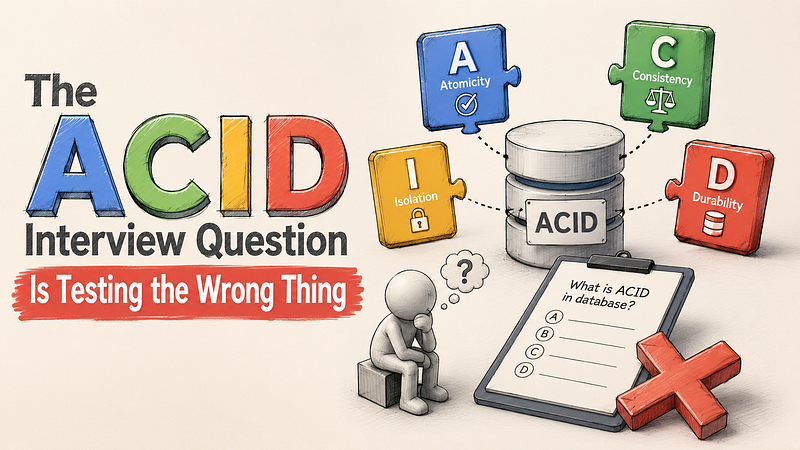
Imagine, you just shipped an order processing system. It handles thousands of transactions per day. Every failed payment rolls back cleanly. Concurrent checkouts for the last item in stock never double-sell. The audit log is always consistent, even after a server restart mid-request. The system works exactly the way a database system is supposed to work.
Then an interviewer asks you to explain the four ACID properties.
You blank!.
Not because you don’t understand transactions. You’ve been writing them correctly for years. You blank because nobody ever asked you to label what you were doing while you were doing it. The code knew. You didn’t need the vocabulary.
This is what the ACID interview question actually exposes and it isn’t a knowledge gap. It’s a translation problem. The question tests whether you can name a framework for behavior your code has been enforcing all along. That is not the same as testing whether you know how transactions work.
What Most Developers Believe
The common assumption is that ACID is something you learn, then apply. You study the definitions, understand the acronym and then write correct transactional code. If you can’t recite the letters, you probably don’t really understand database transactions. That’s the implicit contract embedded in the question.
The problem is that this sequence runs backwards. Most developers write ACID-compliant code first, guided by framework conventions and code review feedback and learn the formal vocabulary much later if at all. The competence precedes the label.
Why That Model Breaks
Frameworks make ACID the default. You don’t opt into atomic transactions in Laravel. They’re what you get when you use DB::transaction(). You don't configure InnoDB for durability. That's the storage engine's baseline behavior. The abstraction is so complete that a developer can write production-grade transactional systems for years without once thinking "I need to enforce atomicity here."
Consider this standard Laravel 12.x code:
// Creating an order atomically: all writes succeed or none do
DB::transaction(function () use ($cart, $user) {
    $order = Order::create([
        'user_id'    => $user->id,
        'total'      => $cart->total(),
        'status'     => 'pending',
    ]);

    foreach ($cart->items as $item) {
        OrderItem::create([
            'order_id'   => $order->id,
            'product_id' => $item->product_id,
            'quantity'   => $item->quantity,
            'price'      => $item->price,
        ]);
        $item->product->decrement('stock', $item->quantity);
    }
    Payment::process($order);
});
There is no BEGIN TRANSACTION. No COMMIT. No ROLLBACK call anywhere. If Payment::process() throws, Laravel rolls back every write in that closure automatically. The developer wrote zero explicit transaction management code and the result is fully atomic. ACID property A: enforced by the framework API.
Now consider the consistency angle. The foreign key constraint on order_items.order_id ensures an order item cannot exist without a parent order. That constraint is defined in a migration. Consistency, the C, is enforced by the schema and not by application logic. The developer never thought "I need to maintain consistency here." They just wrote the migration correctly.
Isolation is the interesting one. MySQL’s InnoDB engine defaults to REPEATABLE READ isolation. That choice means if two concurrent transactions both read the current stock level of a product and both attempt to decrement it, the behavior is defined and predictable. Neither transaction reads uncommitted writes from the other. The developer who wrote that decrement() call did not choose REPEATABLE READ. InnoDB chose it years before that developer wrote their first line of Laravel code.
Durability barely needs explaining at the application layer. Write a record, commit a transaction and InnoDB writes it to the redo log before acknowledging the commit. If the server loses power a millisecond later, the record survives. No developer action required. No acronym knowledge required.
The Mechanism: Why Developers Can Implement Without Naming
ACID describes a set of guarantees that a relational database engine provides at the storage layer. It is a specification, not an instruction manual. The specification is enforced by InnoDB (or PostgreSQL, or whatever engine you’re running), not by application code.
This distinction matters because it means the developer’s job is to use the database correctly, not to implement the ACID properties themselves. When you call DB::transaction(), you are invoking InnoDB's transaction subsystem. When you define foreign key constraints, you are specifying consistency rules that the engine enforces. When you run MySQL, REPEATABLE READ is already selected for you before you write a single query.
The developer who understands this is more useful in production than the developer who can recite all four definitions. They know what the database is handling on their behalf and they know when to reach deeper.
Where it gets nuanced and where the vocabulary actually becomes useful, is isolation levels. REPEATABLE READ is not always the right choice. Consider a reporting dashboard that reads account balances while a payment is in progress. Under REPEATABLE READ, that dashboard sees a snapshot from when its transaction started. The payment might have completed, but the dashboard doesn’t know yet. That’s fine for a dashboard where slight lag is acceptable. For a fraud detection query that needs to see the absolute latest committed state, you want READ COMMITTED instead:
// Switching to READ COMMITTED for a fraud check that needs fresh data
DB::statement('SET TRANSACTION ISOLATION LEVEL READ COMMITTED');

DB::transaction(function () use ($accountId) {
    $balance = Account::lockForUpdate()->find($accountId)->balance;
    // This read sees the latest committed state, not a cached snapshot
    FraudCheck::evaluate($balance);
});
This is the practical decision the interview question should be unlocking. Not “can you name the four letters” but “do you know when REPEATABLE READ bites you and what to reach for instead?”
The four isolation levels InnoDB supports, per the MySQL 8.4 Reference Manual, are:
READ UNCOMMITTED
- Reads uncommitted writes from other transactions; dirty reads are possible
- Rarely the right choice; exists for bulk reporting where absolute consistency matters less than speed
READ COMMITTED
- Each read sees the latest committed snapshot, even within the same transaction
- Common in high-write environments where REPEATABLE READ’s snapshot causes stale reads
REPEATABLE READ
- The InnoDB default; reads within a transaction see the same snapshot established at the first read
- Prevents dirty reads and non-repeatable reads; phantom rows are blocked by gap locks in InnoDB’s specific implementation
SERIALIZABLE
- Treats all reads as locking reads; forces transactions to fully serialize
- Eliminates all anomalies at the cost of serious throughput reduction; intended for XA transactions or deadlock debugging
A developer who knows these four isolation levels and when each bites them is more valuable in a database design conversation than a developer who can spell out “Atomicity, Consistency, Isolation, Durability” in order. One of these is practical judgment. The other is vocabulary.
The Durability Practical Case (Often Skipped)
Durability gets the least attention in interview prep because there’s no application-level decision to make. InnoDB writes every committed transaction to the redo log before confirming the commit. If the process dies, the server reboots, the disk flushes incorrectly, InnoDB replays the log on startup and the data is there. The developer cannot break this. There is nothing to configure.
The one place it becomes relevant is replication lag. Your primary commits a write and confirms it. A replica applies it asynchronously, seconds later. A read hitting the replica during that window returns stale data. That’s not a durability failure on the primary. That’s a consistency question about the replica and it’s a completely different problem. Conflating the two in an interview answer is the tell that someone has memorized definitions without working through the failure modes.
What Breaks When You Conflate the Two
The real cost of treating recall as competence shows up in code review. A developer who can recite ACID but doesn’t understand the abstraction will sometimes write things like this:
// Not atomic: each insert commits immediately in its own implicit transaction
try {
    $order = Order::create([...]);
    OrderItem::create([...]);
    $product->decrement('stock');
} catch (\Exception $e) {
    // What exactly are we rolling back here?
    Log::error('Order creation failed', ['error' => $e->getMessage()]);
}
The catch block logs the error. The order record might already be in the database. The stock was decremented. None of that reverses because there was no wrapping transaction. This code has a developer who knows the word “atomic” but has never thought about what it means to enforce it.
Flip side: a developer who doesn’t know the acronym but writes DB::transaction() everywhere it belongs has never had this bug. They didn't need the vocabulary. The framework usage was correct.
The gap between these two developers is not about ACID knowledge. It’s about whether someone understands what DB::transaction() is actually doing under the hood. That's the question worth asking.
What to Do About the Interview
The disconnect isn’t a reason to ignore the definitions. Knowing the vocabulary matters for two concrete reasons: communicating with DBAs and participating in system design discussions. When someone says “we need to ensure durability across replica failover,” you need to understand what they’re asking. When someone says “the isolation level might cause phantom reads here,” you need to follow the conversation.
Learn the labels. Then attach them to what you already know.
If you already write DB::transaction() correctly, you're enforcing atomicity. Name it that way. If you've ever defined a foreign key constraint or a NOT NULL check, you've been specifying consistency rules. Isolation is where most of the practical decisions live; understand the four levels and one scenario where each default would fail you. Durability is mostly infrastructure: InnoDB's redo log, crash recovery, write-ahead logging. Know that it exists and understand that its trade-off is write latency.
The pattern that actually works in the interview room: lead with the mechanism, not the definition.
Instead of “Atomicity means a transaction is all-or-nothing,” say: “Atomicity is what DB::transaction() enforces for you. If any write in the closure throws, the whole thing rolls back. The code I write assumes that contract."
That answer tells an interviewer more than the textbook definition. It signals that you understand what the framework is doing on your behalf, that you know where the abstraction lives and that you’ve thought about the failure mode. (It also quietly proves you’ve been there when the rollback was the thing that saved you.)
The Line That Actually Matters
The question isn’t wrong. Testing whether a developer understands transactional guarantees is legitimate. What’s wrong is treating acronym recall as the proxy for that understanding.
A developer who can recite ACID perfectly but reaches for try/catch around individual database inserts rather than a transaction block does not understand atomicity. A developer who writes DB::transaction() correctly but doesn't know what A stands for does understand it.
Know the vocabulary well enough to have the conversation. Know the mechanisms well enough to not need a conversation.
The vocabulary is worth having. It just isn’t the proof.