The three isolation strategies, their real costs and the architectural call that breaks your migration plan.
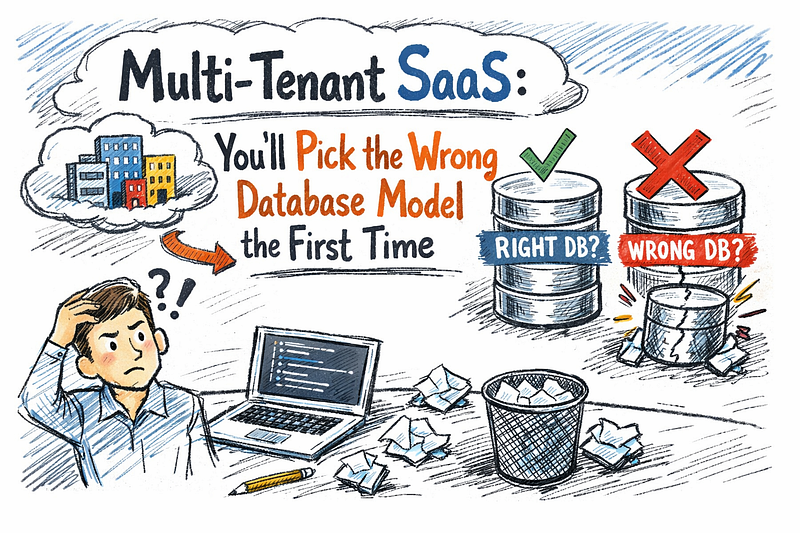
Somewhere around tenant number forty, something cracks. Maybe it’s a bug report from Client A who can see records they shouldn’t. Maybe it’s a migration script that takes six minutes per tenant and you have four hundred of them. Maybe it’s a compliance audit where the legal team asks you to explain, in plain language, how you guarantee data isolation, and the honest answer is “we added a WHERE clause and hoped for the best.”
This is where multi-tenancy stops being an architecture choice and starts being a debt you’re paying interest on.
The problem isn’t that developers pick the wrong model. It’s that tutorials present the three main approaches as roughly equivalent options and let you walk away thinking the choice is cosmetic. It’s not. The database isolation model you choose in week one shapes your migration complexity, your security posture, your connection pooling strategy and your per-tenant operational costs for the next several years. Getting it wrong doesn’t mean the product breaks immediately. It means you spend a quarter untangling it two years later when you can least afford to.
Here’s what the tutorials don’t tell you.
Three Models, Three Different Kinds of Pain
The core strategies for multi-tenant data isolation in a relational database come down to three patterns.
The pool model puts all tenants in the same tables. Every row carries a tenant_id column, and you rely on application logic or Row Level Security policies to ensure tenants only see their own data.
The bridge model gives each tenant their own schema within the same database instance. Tenant A gets a tenant_a schema, Tenant B gets tenant_b and your queries set the search_path at connection time to route to the right one.
The silo model goes further: each tenant gets an entirely separate database. Complete isolation, separate connection pools, separate backups, separate everything.
Most teams default to the pool model. Some genuinely should. But the gap between “default choice” and “right choice” is where the pain lives.
Here’s what each model actually looks like at the structural level before you layer in any application logic.
POOL MODEL                        BRIDGE MODEL                     SILO MODEL
─────────────────────────         ────────────────────────────     ─────────────────────────
 saas_db (one database)            saas_db (one database)           tenant_a_db
┌───────────────────────┐         ┌──────────┐  ┌──────────┐      ┌─────────────────────┐
│  public schema        │         │ tenant_a │  │ tenant_b │      │ public schema       │
│                       │         │ schema   │  │ schema   │      │  projects           │
│  projects             │         │          │  │          │      │  users              │
│  ┌────┬───────────┐   │         │ projects │  │ projects │      │  invoices           │
│  │ id │ tenant_id │   │         │ users    │  │ users    │      └─────────────────────┘
│  ├────┼───────────┤   │         │ invoices │  │ invoices │
│  │ 1  │  tenant-a │   │         └──────────┘  └──────────┘       tenant_b_db
│  │ 2  │  tenant-b │   │                                          ┌─────────────────────┐
│  │ 3  │  tenant-a │   │         No tenant_id column needed.      │ public schema       │
│  └────┴───────────┘   │         Schema boundary = isolation.     │  projects           │
│                       │                                          │  users              │
│  RLS policy filters   │                                          │  invoices           │
│  rows per request.    │                                          └─────────────────────┘
└───────────────────────┘
The Pool Model: Right Most of the Time, Dangerous When You Forget Why
The shared-table approach with PostgreSQL Row Level Security is the industry default for good reason. One schema to migrate, one set of indexes to tune and database resource overhead that scales with actual data volume rather than tenant count. For a SaaS product that expects hundreds to thousands of small tenants with similar usage patterns, this is almost certainly the right starting point.
Every table in your system carries tenant_id. The table structure is flat and shared.
-- All tenants share every table. The tenant_id column is your only logical separator.
CREATE TABLE projects (
    id          UUID        PRIMARY KEY DEFAULT gen_random_uuid(),
    tenant_id   UUID        NOT NULL REFERENCES tenants(id),
    name        VARCHAR(255) NOT NULL,
    created_at  TIMESTAMPTZ NOT NULL DEFAULT NOW()
);

-- Without this index, every query scans the full table instead of the tenant's slice.
CREATE INDEX idx_projects_tenant_id ON projects (tenant_id);
The RLS setup itself is straightforward. You enable row-level security on a table and create a policy that filters based on a session variable your application sets at the start of each request.
-- Enable RLS enforcement on the table
ALTER TABLE projects ENABLE ROW LEVEL SECURITY;

-- Policy: only return rows matching the session's tenant
CREATE POLICY tenant_isolation ON projects
    USING (
        tenant_id = NULLIF(current_setting('app.current_tenant_id', TRUE), '')::UUID
    );
Your application layer then sets app.current_tenant_id at the start of each database session before any queries run. PostgreSQL enforces the filter at the database level, which means a bug in application code that forgets a WHERE tenant_id = ? clause doesn't leak data. The policy fires regardless.
So far, so good. Here’s where it gets complicated.
The PgBouncer trap. Most production deployments put a connection pooler in front of PostgreSQL, and PgBouncer is the common choice. In transaction pooling mode, which is the efficient mode you actually want, PgBouncer does not guarantee the same server connection is assigned to the same client for the duration of a session. That SET app.current_tenant_id you issued at the start of the request? There's no guarantee it's still in scope when the next query runs.
The practical implication: you can’t just set the session variable once and trust it. You need to set it within the same transaction as every data query, or use PgBouncer in session mode (which defeats most of the connection pooling benefit). Some teams work around this with PgBouncer’s track_extra_parameters configuration, which was extended in version 1.20.0, but it requires careful setup and the list of tracked variables is not unlimited.
The safe pattern is wrapping every data-access operation in a transaction that sets the tenant context first. It works, but it adds friction to every query and means your application has to be disciplined about never running data queries outside a properly scoped transaction.
The noisy neighbor problem. RLS solves data isolation, not resource isolation. If one tenant runs a particularly heavy report query, it hammers the same indexes and buffer cache that every other tenant depends on. At low tenant counts this is academic. At several hundred active tenants with uneven usage patterns, a single large tenant’s batch job can cause latency spikes across the entire application. You have no per-tenant query quotas, no per-tenant connection limits and no mechanism to deprioritize their workload without affecting everyone else.
The forgotten table. One more failure mode worth naming: RLS is opt-in per table. A developer adds a new table, forgets to run ALTER TABLE new_table ENABLE ROW LEVEL SECURITY, and now there's a table with no isolation policy on it. The application probably adds a WHERE tenant_id = ? in the query, so it "works" in practice, but your database-level guarantee just evaporated. A rigorous review process or automated schema audit helps, but this is a recurring gotcha in teams that move fast.
Schema-Per-Tenant: When the Compliance Team Arrives
The bridge model swaps row-level policies for schema-level separation. Each tenant owns their own schema within a shared database instance. Your application sets the search_path to route connections to the correct schema, and no RLS policies are needed because the schemas themselves enforce physical separation at the object level.
Provisioning a new tenant means creating a schema and running your migrations inside it.
-- Provision a new tenant: create their isolated schema
CREATE SCHEMA tenant_acme;

-- Tables have no tenant_id. The schema boundary is the isolation.
CREATE TABLE tenant_acme.projects (
    id          UUID        PRIMARY KEY DEFAULT gen_random_uuid(),
    name        VARCHAR(255) NOT NULL,
    created_at  TIMESTAMPTZ NOT NULL DEFAULT NOW()
);
-- Route the connection to the right tenant before querying
SET search_path TO tenant_acme, public;
-- This query now only sees tenant_acme's rows, with no WHERE clause needed
SELECT * FROM projects;
What the database catalog sees internally for a three-tenant deployment:
saas_db
 ├── public schema          (shared utilities, extensions)
 ├── tenant_acme schema
 │   ├── projects
 │   ├── users
 │   └── invoices
 ├── tenant_globex schema
 │   ├── projects
 │   ├── users
 │   └── invoices
 └── tenant_initech schema
     ├── projects
     ├── users
     └── invoices
Scale that to 5,000 tenants with 20 tables each and you have 100,000 objects in the catalog. That’s the wall this model eventually hits.
This model earns its place in a specific scenario: when you have regulatory or contractual obligations that require stronger isolation guarantees than row-level filtering. Healthcare, finance, legal, government clients. When an auditor asks “how do you ensure Tenant A’s data never surfaces in Tenant B’s context?” pointing at a schema boundary is a cleaner answer than explaining RLS policy semantics.
Schema-per-tenant also enables something the pool model can’t: per-tenant migrations. If Tenant A is on a legacy data structure and Tenant B has already been upgraded, you can manage that independently within each schema. This is operationally messy, but sometimes it’s the right kind of mess.
The limits show up at scale. PostgreSQL’s system catalog stores metadata for every schema, every table, every index. With ten tenants you’ll never notice. With ten thousand tenants, each with fifty tables and twenty indexes, you’re looking at half a million catalog entries. Catalog bloat affects query planning performance, increases memory pressure on catalog caches and makes routine operations like schema enumeration noticeably slow. Published experience from teams running large schema-per-tenant setups generally puts the practical ceiling somewhere in the thousands of tenants before the overhead becomes a serious concern.
Migration management is the other pain point. Running database migrations across hundreds of schemas requires tooling built for it. You’re not just running php artisan migrate once. You're running it for every tenant in sequence or in controlled batches, handling failures per-tenant and doing this reliably enough that a failed migration doesn't leave some tenants on schema version 47 and others on version 46 with no easy way to tell the difference.
If your expected tenant count is in the dozens or low hundreds and you’re operating in a regulated space, schema-per-tenant is genuinely the right answer. If you’re expecting thousands of small tenants and your compliance requirements are standard, you’re adding operational overhead that isn’t buying you much.
Database-Per-Tenant: The Enterprise Default You Probably Can’t Afford
The silo model is the simplest to reason about and the hardest to operate at scale. Each tenant gets a dedicated database instance. Backups are per-tenant. Schema migrations are per-tenant. Performance problems in one tenant’s database don’t touch anyone else’s. An infrastructure incident can be isolated to a single tenant.
Your application server
         │
         ├──► tenant_acme_db    (own connection pool, own backup, own migrations)
         │     └── public schema
         │          ├── projects
         │          ├── users
         │          └── invoices
         │
         ├──► tenant_globex_db  (completely separate PostgreSQL instance or RDS)
         │     └── public schema
         │          ├── projects
         │          ├── users
         │          └── invoices
         │
         └──► tenant_initech_db
               └── public schema
                    ├── projects
                    ├── users
                    └── invoices
Your routing layer holds a config map of tenant slug to database connection string. Adding a tenant means provisioning a new database, running migrations against it and registering the connection. Removing a tenant means tearing down a database instance. At three tenants this feels elegant. At three hundred it’s an ops problem that consumes engineering time.
This makes sense in a narrow set of situations: you have large enterprise clients who contractually require dedicated infrastructure, you’re operating in a regulated industry where physical data isolation is non-negotiable or you have tenants large enough that resource isolation genuinely matters.
The operational cost is substantial. Every tenant adds connection overhead, backup schedules, monitoring surfaces and upgrade operations. A connection pooler becomes mandatory and complex. Your deployment tooling needs to handle fleet-scale database operations rather than single-database operations. For most teams, this is an infrastructure engineering problem that outweighs the benefits unless you have very few, very large tenants.
The Hybrid Approach and the Complexity It Imports
Some teams land on a hybrid: pool model with RLS for small tenants, dedicated schema or database for large enterprise accounts. This is operationally sound reasoning. Your biggest clients get the isolation they’re paying for, your smallest clients don’t burn infrastructure budget and you build revenue before you build complexity.
The challenge is that every layer you add to the isolation strategy is a layer your application code has to understand. Your connection management logic needs to route to the right database or set the right schema based on tenant configuration. Your migration tooling needs to handle at least two different models. Your monitoring and debugging tools need context about which model a given tenant is using. Your oncall runbook doubles.
Incoming request  →  Tenant resolver
                          │
                          ├── tenant.tier = "standard"
                          │       └── shared pool DB
                          │             SET app.current_tenant_id = 'uuid';
                          │             RLS handles the rest.
                          │
                          └── tenant.tier = "enterprise"
                                  └── dedicated DB connection string
                                        SET search_path TO tenant_acme;
                                        -- or connect to tenant_acme_db directly
Every query path now branches. Your test suite needs to cover both branches. So does your migration tooling.
This isn’t a reason not to do it. It’s a reason to be honest about the cost before you commit.
The Migration You Hope Never Comes
Most teams don’t fail at choosing the wrong model on day one. They succeed enough that tenant count grows past the original assumptions, and then they face a migration that was never designed for.
Moving from the pool model to schema-per-tenant means writing a migration that, for each existing tenant, creates a schema, copies their rows into new per-schema tables, updates all foreign key references, validates the copy and then runs in production without taking the app down for existing tenants. Multiply that by however many tenants you have, account for data in flight during the migration window and consider that your application code now needs to support both models simultaneously until the migration completes.
The inverse, moving from schema-per-tenant back to pool, involves the same complexity in reverse plus the risk of merging tenant data into shared tables where a single mistake means a cross-tenant data leak.
The cost of migrating between models is not proportional to the difficulty of the original implementation. It’s proportional to how long you’ve been running on the wrong model and how many tenants have accumulated.
A Decision Framework for Small Teams
If you’re a solo technical lead or a small team making this call, here’s the practical version.
Start with the pool model and RLS if your tenant count is expected to be in the hundreds or thousands, your tenants have roughly comparable data volumes and your compliance requirements are standard. This is the right choice for most early-stage SaaS. Build your PgBouncer configuration carefully, enforce RLS at the database level and add schema auditing to your deployment process.
Use the schema-per-tenant model if you operate in a regulated space where schema-level isolation is an auditable compliance control, or if your tenant contracts explicitly require it. Accept the migration tooling overhead upfront. Keep your expected tenant count in the hundreds, not thousands.
Consider database-per-tenant only if your largest clients are also your most important clients and they have real infrastructure isolation requirements, not just a checkbox on a procurement form. This model makes sense when client size justifies the operational overhead.
The hybrid model earns its complexity when you’re past initial product-market fit and have enough revenue to fund the operational tooling it requires.
The real mistake isn’t picking the wrong model for your current state. It’s picking the model that fits your current tenant count without pricing in what happens when your biggest client is ten times larger than your average client and their data volume makes shared-table queries noticeably slower for everyone else.
That’s when you find out what your original architectural decision actually cost.
Pick the model that fits your tenant variance, not your tenant count.