Your cloud bill does not usually explode overnight. It grows quietly through production decisions nobody reviews until the invoice becomes painful.
The application is healthy. No outage. Traffic looks normal. Developers are shipping. Then the monthly invoice arrives and the number is much higher than expected. Finance asks what happened. Engineering opens the billing dashboard and realizes the cost has been climbing quietly for weeks.
That moment gets framed as a finance problem almost every time. It is not. It is a production signal.
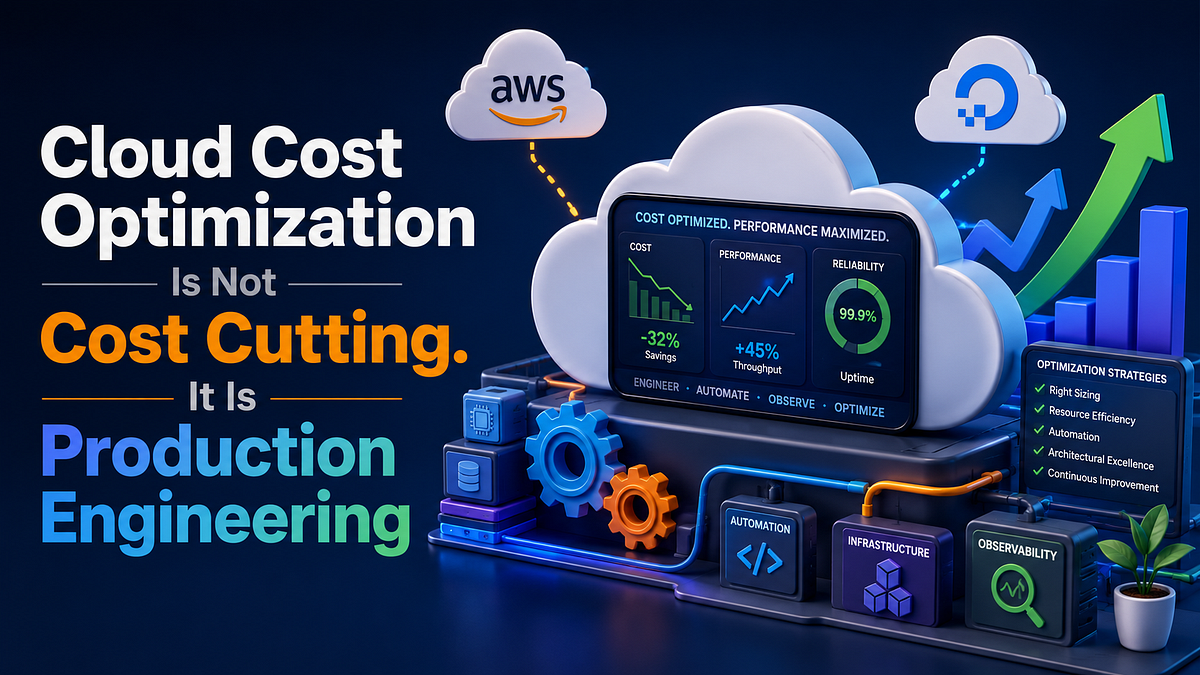
Cloud cost optimization gets misunderstood because people hear the word optimization and immediately picture budget cuts, smaller servers and a tense meeting where somebody suggests deleting logs. That is not optimization. That is panic. Real optimization is a production discipline. It asks how the system consumes compute, storage, network, observability and third-party services. It looks for waste, but it also protects reliability, performance, security and the sanity of the engineers who have to run the thing.
If a cost reduction gives you slower incidents, thinner monitoring, weaker backups or a tired team that has to hand-restart jobs at midnight, you did not optimize anything. You just moved the bill into another category.
Cloud cost is a production signal
A rising bill can mean the product is growing. Good. It can also mean resources are oversized, storage retention is unmanaged, background jobs are doing unnecessary work or a feature is quietly creating expensive traffic patterns. Also good to know.
The point is that cost reflects production design whether you pay attention to it or not.
Latency tells you how fast the system responds. Error rate tells you when it is failing. Storage growth tells you something about retention and product behavior. Cost belongs in the same family. It is one of the outputs of architecture, deployment habits, workload shape and operational discipline.
That is why mature teams stop asking, “How do we make the bill smaller?” and start asking, “What changed in the system, and was that spend intentional?” Those are not the same question.
Healthy cost growth usually has a story you can explain. More customers. More documents processed. More jobs completed. More data retained because the business now depends on it. Waste has a different story. Nobody knows who owns the resource, why the replica exists, why the logs never expire or why staging still runs at full size when the office is asleep.
Engineering needs to know the difference. Finance cannot answer that from the invoice alone.
Why cloud bills spike under our nose
Most cloud waste is boring. That is exactly why it survives.
Bills rarely jump because of one dramatic mistake. They grow through many small habits that feel harmless on their own:
- oversized compute that nobody resized after launch
- staging and test environments left on all month
- debug logging that never got turned down
- object storage filling with temporary files that became permanent
- old snapshots and backups nobody reviewed
- misconfigured autoscaling that protects comfort more than traffic
- database queries doing too much work every minute
- workers polling all day for jobs that show up twice an hour
- observability ingestion growing faster than product usage
- forgotten proof-of-concept resources with no owner
This is why cloud cost can feel slippery compared to a traditional hosting bill. The spend is distributed. A little more in logs. A little more in storage. A little more in egress. A little more in database size. A little more in managed services you adopted to move faster. None of it looks dramatic until you add it up.
AWS makes this very easy to do because the platform gives you deep control and many service choices. That is a strength. It also means cost can hide in more places. NAT Gateway processing, CloudWatch ingestion, old load balancers, ECS tasks sized for peace of mind instead of evidence, snapshots nobody cleaned, S3 buckets with no lifecycle rules. Powerful platforms reward ownership. They also punish indifference.
DigitalOcean is simpler, but the pattern does not disappear there. A team can still leave idle Droplets running, oversize a managed database, keep old snapshots forever, forget detached volumes, run workers continuously when queues are empty and keep a test load balancer around because nobody wants to touch it. Simpler infrastructure just means fewer hiding places, not zero hiding places.
Why the AI era makes cloud cost harder to control
AI changes the shape of cloud cost in a way many teams still underestimate.
Traditional SaaS systems usually scale in ways engineers already recognize: page views, request volume, database growth, queue throughput, storage. AI workloads add more moving parts. Token usage. Embeddings. document parsing. vector search. background summarization. transcription. image generation. repeated prompt testing. agent loops that look clever until they start doing paid work at scale.
The dangerous part is not just that these workloads cost money. It is that the cost can scale with behavior that is harder to spot from normal traffic graphs. A single user uploading one huge document might cost more than a hundred page views. A retry loop in an agent can quietly multiply model calls. A larger context window can make a successful feature more expensive even when request counts stay flat.
That is why AI prototypes mislead teams. The demo looks cheap because usage is low, documents are small and concurrency is polite. Then the feature reaches real customers. Files get larger. Usage gets bursty. The prompts get longer because product wants more context. Automated workflows start calling models in the background. Suddenly the cost is no longer tied neatly to simple request count.
If an AI feature cannot tell you, roughly, what it costs per workflow, per document, or per active user, it is not production-ready. That is not anti-AI. It is basic operational hygiene.
The wrong way to optimize cloud cost
The fastest way to damage a system is to treat all spend as waste.
I have seen teams shrink database instances because CPU looked low while memory pressure, IOPS, or connection spikes were the real constraint. I have seen log retention cut so aggressively that incident response became guesswork. I have seen teams disable backups, remove redundancy, turn off workers and then act surprised when queue delay becomes a customer problem instead of a dashboard number.
Cheaper infrastructure is not automatically better infrastructure. Sometimes it is just underfunded infrastructure.
The wrong optimization instincts usually sound like this:
- “Make everything smaller.”
- “Turn off anything that is not production.”
- “Reduce monitoring. It is too expensive.”
- “We can drop the CDN for now.”
- “Let us move it all to one server.”
Every one of those ideas can be correct in one system and reckless in another. That is the whole point. Cost work without workload understanding is not engineering. It is superstition with billing access.
Start with visibility before touching infrastructure
Before you right-size anything, you need to know what is growing, who owns it and whether the spend is tied to real usage or waste. Otherwise optimization becomes guessing with consequences.
Start here:
- break down spend by service
- separate production, staging and development
- tag resources by environment, owner and project
- set budget alerts and anomaly alerts
- watch daily burn rate, not just the monthly invoice
- track the top five cost drivers
- compare cost against traffic, revenue and feature usage
AWS gives you real tools for this. Budgets, anomaly detection and cost allocation practices are all there. DigitalOcean has billing alerts, projects and tags. None of those solve cost by themselves. They just make ownership possible. Without visibility, every optimization meeting becomes a room full of guesses.
The practical questions are simple:
- What service is growing?
- Which environment owns it?
- Which feature or workflow uses it?
- Is the growth tied to real customer behavior?
- What breaks if we reduce it?
If nobody can answer those, do not touch production yet.
Compute optimization without breaking the app
Compute optimization should be based on measurement, not instinct.
Teams often look at low CPU and conclude the server is too large. That can be true. It can also be dangerously incomplete. Maybe the instance is memory-bound. Maybe queue workers spike during nightly jobs. Maybe one mixed workload is hiding the behavior of three different workloads that should have been separated a long time ago.
A better approach is boring and disciplined:
- review CPU and memory trends together
- separate web traffic, workers and scheduled jobs when their behavior differs
- load test before downsizing
- use autoscaling for real demand instead of emotional comfort
- turn off non-production workloads outside working hours where that does not hurt the team
- review container CPU and memory allocation instead of treating defaults as truth
On AWS, this often shows up in ECS or EC2 sizing. ECS task definitions force explicit CPU and memory choices, which is useful because it makes over-allocation visible if you bother to review it. On DigitalOcean, the same issue appears as Droplets that were sized for launch-day uncertainty and never revisited after traffic patterns stabilized.
One practical example: a team sees low CPU and wants to shrink the server. But memory is already close to the edge and queue workers spike during batch jobs. The right move is not one smaller machine. The right move is to separate web traffic from worker traffic, size them independently and scale workers from queue depth or job timing instead of from guesswork.
Database optimization is surgical work
Database cost is where engineering discipline shows up fast, because the database often becomes expensive for reasons the provider did not invent. The application did.
Missing indexes, N+1 queries, over-fetching, long-running reports, dashboards that refresh too often, connection pools that are never revisited, cold data that never gets archived, read replicas that solve symptoms instead of causes. Those are application decisions with infrastructure invoices attached.
Sometimes the provider tier is genuinely too large. Sometimes the provider is not the main problem at all. The application is asking the database to do unnecessary work every minute, and the bill is just the most patient person in the room.
This is true on RDS, on DigitalOcean Managed PostgreSQL and on self-managed databases alike. The optimization playbook is still careful work:
- review slow queries and query plans
- fix indexing before buying bigger compute
- archive cold data where the business allows it
- review backup retention with an actual recovery objective in mind
- verify whether read replicas are solving load or masking bad queries
You do not want finance leading this part. They are not the people who have to recover the system if the database gets smaller in the wrong way.
Logs, storage and backups are silent multipliers
Logs and backups are necessary. They are also some of the easiest places to leak money without noticing.
Structured logging everywhere sounds responsible until somebody ships huge payloads into the logs, leaves debug level on in production, or keeps everything forever because nobody wants to decide what matters. Object storage behaves the same way. Old exports, temporary files, duplicate uploads and abandoned multipart uploads keep sitting there because the system has no cleanup design.
This is where retention policy matters more than austerity. CloudWatch log groups can have retention changed per group. DigitalOcean Spaces lifecycle rules can expire objects after a chosen number of days and clean up incomplete multipart uploads automatically. DigitalOcean snapshots are retained until someone deletes them. Those details matter because “we will clean it up later” is not a policy. It is how storage quietly becomes part of the monthly surprise.
The trade-off is simple and real. Remove logs blindly and incidents get harder to investigate. Keep every log forever and observability becomes a cost leak. The grown-up answer is retention design, selective logging, sampling where it is appropriate and ownership over who gets to generate high-volume telemetry.
Network cost hides inside architecture
Application engineers often feel network spend as a billing line item long before they understand what architectural decision created it.
AWS NAT Gateways are a good example. They are useful. They are also billed by provisioned time and by data processed, which means architecture choices around private subnets, internet access and traffic patterns can quietly become recurring cost. Cross-AZ transfer can add more. That is not a reason to avoid NAT. It is a reason to know when traffic is flowing through it and why.
The same pattern shows up in other forms:
- large file uploads proxied through the app server instead of going direct to object storage
- service-to-service chatter that scales with every request
- cross-region replication nobody reevaluated
- CDN bypasses that shift origin load back to compute
- container images pulled repeatedly because cache strategy is poor
If users upload large files and your app server proxies every upload and download, bandwidth cost and compute cost can rise together. A better pattern may be signed uploads to object storage, signed downloads, CDN caching where it makes sense and lifecycle rules for cleanup. That is not finance advice. That is architecture.
AI workloads need cost guardrails from day one
AI features need cost controls in the design, not in the apology after launch.
That means tracking token or model cost by feature, by workflow and by environment. It means using smaller models when the task allows it. It means capping context size, batching work when it is safe, caching repeated results where correctness allows it and putting clear retry limits around expensive automated flows.
It also means separating experiments from production billing. If product and engineering want to explore agents, summarization, document pipelines or code generation helpers, fine. But those experiments need boundaries. Quotas. ownership. stop conditions for loops. budget alerts before the monthly bill becomes your monitoring system.
The opinionated version is simple: if an AI workflow cannot tell you what it costs per user, per document, or per automated task, it is not ready to scale. It may still be a good experiment. Keep it as an experiment until the cost behavior is legible.
Two realistic examples: AWS and DigitalOcean
Think of these as two different cost surfaces. The point is not which provider is better. The point is how the same production habits create cost in different shapes.
AWS example: stable traffic, rising bill
A team runs a Laravel API on ECS behind an Application Load Balancer, with RDS PostgreSQL, ElastiCache Redis, S3 and CloudWatch. The bill increases even though traffic is stable.
This is how I would work the problem as the engineering owner.
What finance asks: why did the invoice go up if the product did not obviously grow?
What management needs: a clear answer about whether this is healthy growth, waste, or a temporary spike, plus a remediation plan that does not create new production risk.
What the technical team has to do first: stop arguing about ECS, RDS, or CloudWatch in the abstract and break the increase down by service, by environment, and by ownership. The first pass is not optimization. The first pass is attribution.
Investigation shows:
- CloudWatch log ingestion is too high because application logs are noisy and some groups still retain data longer than the team actually needs.
- Staging ECS tasks run 24/7 even though the team mostly uses the environment during working hours.
- RDS storage has grown because old records are never archived and several reporting queries keep touching hot storage unnecessarily.
- NAT Gateway cost increased because private workloads keep pulling data and packages from the public internet through the same path.
- Old snapshots were never cleaned up after previous rollouts and recovery tests.
- ALBs still exist for abandoned environments that no longer serve meaningful traffic.
- ECS task CPU and memory allocation is larger than actual usage because the team sized tasks conservatively early on and never revisited them.
That list matters because now finance gets a real explanation. The bill did not rise because “AWS is expensive.” It rose because observability, idle staging capacity, networking, storage growth and abandoned infrastructure all added recurring cost without active review.
Optimization approach:
- Set CloudWatch log retention deliberately instead of leaving noisy groups to grow by habit.
- Reduce debug-heavy log output so ingestion cost reflects useful signals rather than panic-level verbosity all day long.
- Add lifecycle rules for S3 where temporary exports or generated files do not need permanent retention.
- Schedule staging workloads so they are available when developers need them, not all night by default.
- Review ECS task CPU and memory allocation against actual usage, then right-size carefully instead of downsizing blindly.
- Right-size RDS using CPU, memory, connection count, storage growth and IOPS, not just a quick look at average CPU.
- Archive cold database records so the primary database stops paying to behave like a long-term warehouse.
- Reduce NAT Gateway usage where the traffic pattern can be redesigned safely.
- Remove unused load balancers tied to dead environments.
- Clean up old snapshots with a retention rule instead of a vague promise to tidy them later.
- Tag resources by environment, owner and project so the next investigation is faster and less political.
- Set AWS Budgets and anomaly alerts so finance hears about abnormal growth before the invoice becomes the alert.
How I would explain the result back to the business: the system is healthy, but the cost profile is not well-governed enough. We are not dealing with one broken service. We are dealing with several small production habits that became recurring spend. The fix is controlled engineering cleanup, not emergency cost cutting.
Key AWS framing: AWS gives powerful services and deep control, but it also creates many places for hidden cost to appear. The more services you use, the more ownership you need.
DigitalOcean example: simpler platform, same bad habits
A small SaaS team runs a web app on a DigitalOcean Droplet, PostgreSQL Managed Database, Redis, Spaces and a Load Balancer. Later, they add a staging server, background workers and document uploads. The bill grows slowly.
This is easier to ignore because the bill is smaller than a typical larger-cloud footprint. That is exactly why the waste sticks around longer.
What finance asks: if the platform is supposed to be simpler and cheaper, why does the number keep drifting up every month?
What management needs: a clear statement that the team does not have a provider problem first. It has an operating-discipline problem. The platform is simple enough to understand. The spend still grew because nobody kept reviewing how the environment changed over time.
What the technical team has to do first: map the bill to actual resources and active workflows. Simpler clouds reduce the number of billing surfaces, but they do not remove the need for ownership.
Investigation shows:
- Idle staging Droplets run all month even though the team only needs them during certain windows.
- The Managed Database tier is larger than needed because it was upsized during a busier period and never reviewed again.
- Spaces contains old uploaded files with no cleanup policy, so temporary and obsolete data quietly becomes permanent storage.
- Backups and snapshots are retained longer than necessary because nobody revisited the retention policy after the original setup.
- Detached volumes are still billed because they were never cleaned up after tests and migrations.
- Workers run all day even when queues are empty or close to empty.
- A Load Balancer still exists for an abandoned test environment.
- Kubernetes was introduced for a workload that could run on simpler infrastructure, which added platform overhead before the workload justified it.
Again, that gives finance and management something concrete. The provider did not become irrational. The environment accumulated idle resources, oversized plans, retained storage and unnecessary platform complexity.
Optimization approach:
- Resize Droplets based on real CPU and memory usage, not the fear profile from the month the system launched.
- Turn off or schedule staging environments when that will not harm developer productivity.
- Review the Managed Database tier against actual utilization, storage growth and workload shape.
- Clean unused volumes instead of letting detached storage become invisible recurring spend.
- Add lifecycle cleanup for uploaded files that do not need permanent retention.
- Review backup and snapshot retention intentionally rather than letting the safest-sounding default become the permanent answer.
- Scale workers based on queue demand instead of leaving them running all day from habit.
- Remove unused Load Balancers tied to environments nobody owns anymore.
- Avoid Kubernetes unless the workload and team maturity justify the operational complexity.
- Use project-level ownership, tags and budget alerts so the next cost review starts with facts instead of archaeology.
How I would explain the result back to the business: the platform is still simple, but simple does not mean automatically cheap. We are paying for idle capacity, unmanaged storage, retained backups and a few platform choices that stopped matching the workload.
Key DigitalOcean framing: DigitalOcean is simpler and easier to reason about, but simple does not mean automatically cheap. Cost can still grow through idle resources, oversized plans, unmanaged storage and unnecessary platform choices.
The opinionated point both examples lead to
The cheaper platform does not fix poor production habits. A team can waste money on AWS through complex architecture and unmanaged services. The same team can waste money on DigitalOcean through oversized Droplets, idle staging servers, unnecessary Kubernetes clusters and unmanaged storage. The real problem is not the cloud provider alone. The real problem is when nobody owns cost as a production metric.
Cost optimization should be part of engineering culture
The best teams do not wait for finance to ask what happened. They review cost the same way they review reliability risks before a launch or architecture trade-offs before a migration.
That shows up in habits:
- monthly cost reviews owned by engineering
- budget and anomaly alerts that people actually read
- architecture discussions that include cost impact
- resource ownership for expensive services
- cleanup days for abandoned infrastructure
- cost checks before major AI features ship
- post-incident review when a change creates a spend spike
Finance absolutely has a role. They can see the invoice and ask the right hard question: why did this number change? But engineering has to answer what changed in the system. Cost ownership belongs in engineering because engineering decisions create most of the spend profile.
Practical checklist
Ask youself:-
- Do we know our top five cloud cost drivers?
- Are resources tagged or grouped by environment and owner?
- Are staging workloads running all day without a reason?
- Are old snapshots and backups reviewed on purpose?
- Are logs retained longer than they need to be?
- Are AI features monitored by request, user, document or workflow?
- Are slow queries increasing compute or database cost?
- Are workers scaled from queue depth or schedule instead of hope?
- Are we paying for idle infrastructure?
- Do budget alerts arrive before the invoice shock?
- Do we review cost before launching major features?
- Can we explain cost growth with product usage data?
- Do we know which workloads are business-critical?
- Are temporary files turning into permanent storage?
- Are abandoned test environments still running?
- Are AI experiments isolated from production billing?
- Do we know the cost per customer, job, document or request for expensive workflows?
If you check all of it, 99.99% nothing would go wrong.
Final thought
Cloud cost optimization is not a cleanup project you run after finance gets angry. It is part of operating production systems well.
The strongest teams build visibility, ownership and guardrails so cost, performance and reliability are managed together. They do not confuse cheaper with better. They do not wait for the invoice to reveal that something changed. They treat cloud cost like any other production signal worth understanding before it becomes painful.
Cloud cost optimization is not about becoming cheap. It is about becoming aware, intentional and disciplined in production. When was the last time your team reviewed cloud cost before finance asked about it?